A rack of ribs can be fully cooked and still eat like shoe leather. That’s why baby back ribs temperature matters in two ways, first for safety, then for tenderness.
If you’ve ever pulled ribs at a pork-safe temp and felt let down, you didn’t do anything strange. Ribs need more time and heat than chops or tenderloin. Once you know the right ranges and how to read doneness, the whole process gets easier.
The two temperatures every rib cook should know
When people talk about the “right” internal temperature for baby back ribs, they often mix up two different goals.
The first goal is safety. Pork is safe to eat at 145 F, followed by a 3-minute rest. If you hit that mark, the meat is cooked in the food safety sense.
The second goal is tenderness. Ribs usually don’t feel tender until they climb much higher, often into the 195 F to 203 F range. That’s when collagen has had time to soften and the meat loosens from the bones.
Safe at 145 F does not mean tender. For ribs, the best eating texture usually comes much later.
This quick table makes the difference clear:
| Temperature | What it means | What the ribs feel like |
|---|---|---|
| 145 F | Safe minimum for pork | Firm, chewy, not classic rib texture |
| 165 F to 185 F | Cooked, but usually still tight | Meat may taste done, yet still resist the bite |
| 190 F to 195 F | Start checking for tenderness | Some racks are ready, others need more time |
| 195 F to 203 F | Common finish range for baby backs | Tender, juicy, bones loosen, collagen rendered |
| 205 F and up | Past the sweet spot for many racks | Can turn soft, mushy, or dry |
The takeaway is simple. Don’t stop at the safe minimum if you want barbecue-style ribs.
That doesn’t mean you must chase one exact final number. Ribs are thin, bone-filled, and uneven. One end may read differently than the other. Use temperature as a guide, then confirm with feel.
For another take on common finish ranges, this baby back ribs temp overview lines up with what many backyard cooks see in practice. The main point stays the same: you cook ribs past “safe” so they become pleasant to eat.
Why baby back ribs turn tender above the safe minimum
Ribs come from a hard-working part of the pig. They have connective tissue, surface fat, and thin layers of meat wrapped around bone. Because of that, they behave nothing like a pork chop.
At 145 F, the meat is technically cooked. Yet the collagen hasn’t broken down enough to give you that tender bite. Keep the ribs in a gentle heat zone long enough, and that tissue softens into gelatin. That’s the change you’re chasing.
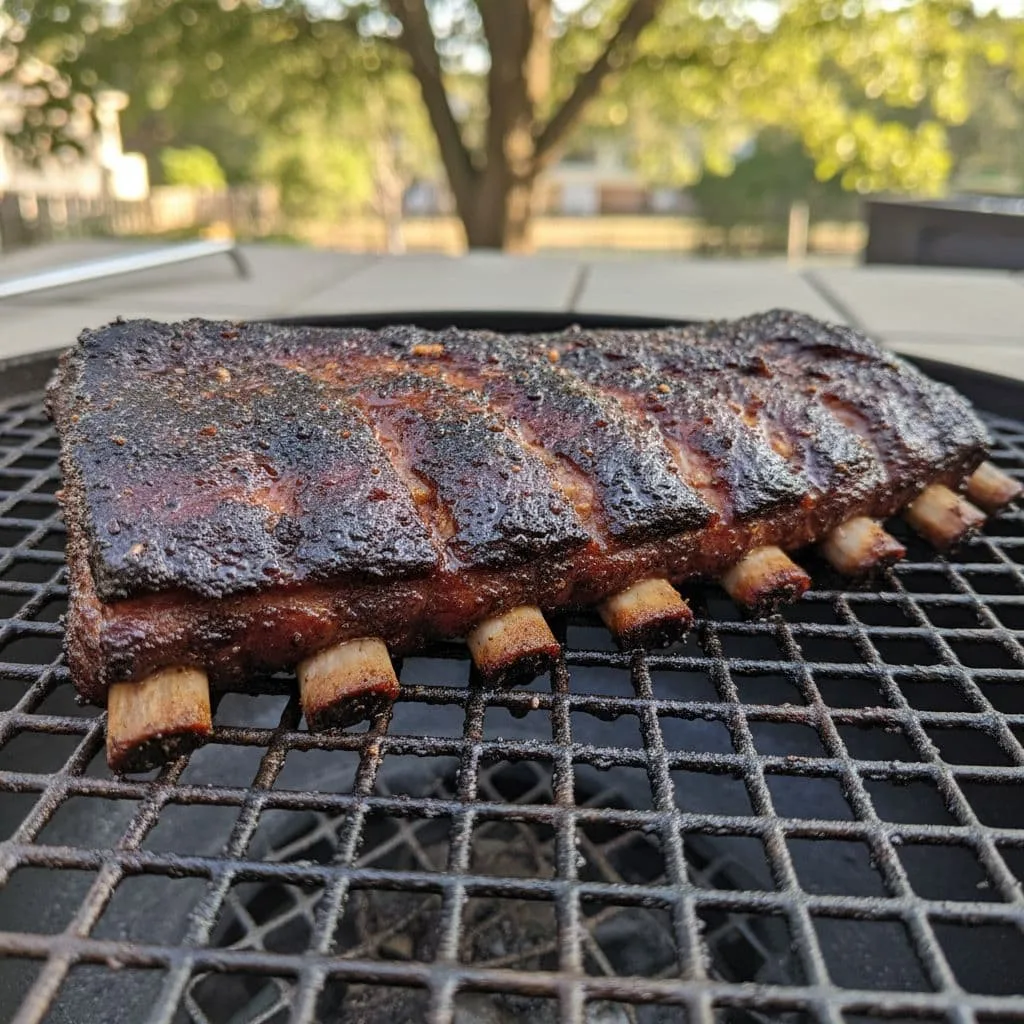
You can also see tenderness on the rack itself. The meat often pulls back from the ends of the bones by about 1/4 to 1/2 inch. If you lift the rack with tongs, it should bend easily. A slight crack in the bark near the bend is a good sign.
The best check, though, is a probe or toothpick between the bones. It should slide in with light resistance, about like warm butter or soft peanut butter. If it still feels springy or tight, keep cooking.
Internal temperature still helps, but ribs are tricky to read. Bones conduct heat, so touching one can give a false number. Thin spots heat faster than thick ones. That’s why a single reading can mislead you.
A better plan is to take several readings, always in the thick meat between bones, and use the average as your guide. Then trust the feel test.
Some cooks like clean-bite ribs, where the meat comes away with a gentle tug. Others want softer, near fall-off-the-bone ribs. Both styles can be good, but the second one usually lands a bit higher in temp and carries a greater risk of drying out. Most home cooks find the sweet spot around 198 F to 203 F.
Best cooker temperatures for smoker, grill, and oven
The internal temperature matters most at the end, but your cooker temperature shapes how the ribs get there. Low to moderate heat gives the fat and collagen time to soften without drying the surface.
Smoker
For a smoker, aim for 225 F to 250 F. That range gives baby backs enough time to build bark and pick up smoke.
At 225 F, expect roughly 5 to 6 hours. At 250 F, many racks finish in 4 to 5 hours. Size, thickness, weather, and how often you open the lid all change the clock, so use time as a loose guide only.
If you wrap ribs in foil or butcher paper partway through the cook, they may finish faster. Many cooks wrap once the color looks good, often when the meat is around the mid-160s to 170s. Wrapping softens the bark a bit, but it can help push through the stall and keep the meat moist.
Grill
A gas or charcoal grill can make excellent ribs if you set it up for indirect heat. Try to hold the grill around 250 F to 300 F, with the ribs away from the flame.
On a charcoal grill, bank the coals to one side. On a gas grill, leave one burner off or keep the center zone cooler. Then place the ribs over the unlit side and keep the lid closed as much as you can.
This method runs a bit hotter than classic smoking, so the ribs may finish sooner. Start checking tenderness once the internal temperature reaches the low 190s.
Oven
The oven is steady and forgiving, which makes it great for beginners. A good range is 275 F to 300 F.
Many home recipes bake baby backs covered for about 2 1/2 to 3 1/2 hours, then uncover them for color and sauce. If you want a simple low-heat baseline, this baby back ribs recipe from Allrecipes follows that covered-then-finish approach.
No matter which cooker you use, the pattern stays the same. Cook at a moderate pit temperature, start checking internal temp near 190 F, and pull the ribs when the probe slides in easily.
How to check baby back ribs temperature, and avoid common mistakes
A good instant-read thermometer helps, but technique matters. If the probe hits bone, you’ll get a bad reading. If you test only one spot, you may miss the thickest part of the rack.
Use the thermometer in the thick meat between bones. Insert it from the top or side at a shallow angle. Check at least two or three spots, especially near the center.
If you have a leave-in probe, use it as a trend tool, not a final judge. Ribs are too thin and uneven for perfect precision. Once you get near 190 F, switch to spot checks with an instant-read thermometer and confirm with a toothpick or skewer.
Temperature gets you close. Feel tells you when the ribs are ready.
These are the mistakes that most often ruin baby back ribs:
- Pulling them at 145 F because that’s the pork safety number. Safe ribs can still be tough.
- Probing against a bone. The reading jumps high and makes the rack seem more done than it is.
- Cooking by time alone. One rack may finish in four hours, another may need five.
- Running the cooker too hot. High heat tightens the meat before the connective tissue has time to soften.
- Saucing too early. Sugary sauce can burn before the ribs are tender.
- Skipping the rest. Give the rack 10 to 15 minutes before slicing so the juices settle.
One more tip helps a lot: remove the thin membrane from the bone side before cooking, if it hasn’t already been removed. That membrane can turn chewy and block seasoning and smoke.
Finally, slice carefully. Turn the rack bone-side up so you can see where to cut. A clean cut keeps more juice in each rib and makes the finished plate look better too.
Tender ribs come from patience, not one magic number
A rack of baby backs is done in stages. It’s safe at 145 F, but it usually turns tender much later, most often around 195 F to 203 F.
Keep your cooker in a steady range, check several spots with a thermometer, and trust the probe feel before the clock. Once you stop chasing one single number, your ribs get a lot more consistent.