
Check salmon doneness by measuring 145°F (63°C) in the thickest center. Check the center with an instant-read thermometer rather than guessing from color, pressing the fish, or relying on a fixed number of minutes. At that endpoint, the flesh should be opaque and separate easily with a fork. To limit dryness, cook evenly sized portions, begin checking early, and remove each portion from the hot cooking surface as soon as it reaches the measured endpoint.
That is the practical answer to salmon doneness: temperature establishes the endpoint, while appearance and texture help you understand how the fish is progressing. They should not be used to justify a lower serving temperature or to assume that carryover cooking will close a temperature gap after the fish leaves the heat.
Salmon doneness: the safe temperature
FDA and FoodSafety.gov guidance lists 145°F for fish, including salmon. Measure the temperature in the thickest center of the fillet. If several portions differ in size, check each one and remove thinner pieces first.
How to measure salmon doneness correctly
Use the right thermometer
A fast digital thermometer with a narrow probe leaves a smaller opening and reads the center more precisely than a thick dial stem. Clean the probe before and after use. If the fish has been in contact with raw seafood, do not let the used probe touch cooked food, plates, or utensils until it has been cleaned.
Insert the probe from the side
For an individual fillet, slide the probe horizontally through the side into the thickest section. Aim for the geometric center of the flesh, not the skin, pan, grill grate, or a thin tapered edge. Side entry places more of the sensing area inside the center and is easier than trying to hit a shallow target from above.
For a large side of salmon, test more than one thick area. The tail end can finish before the center cut. A single reading from the thinnest section does not establish that the entire side is done.
Check more than one portion
Begin with the thickest piece, then check another large piece and any portion that looks less cooked. If one fillet is below 145°F, return only that fillet to the heat. Leaving every piece in the oven while one thick portion catches up is a common way to dry out the thinner pieces.
Visual cues when a thermometer is unavailable
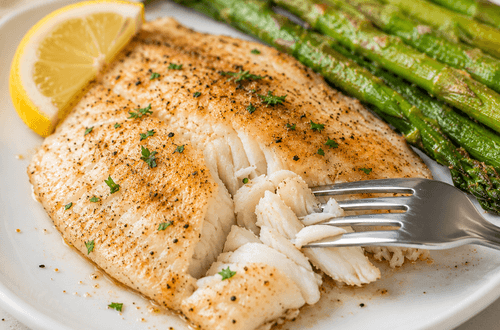
FDA guidance says cooked fish should lose its translucent appearance and separate easily with a fork. Use those cues together, checking the thickest center rather than the surface.
- Color: The center changes from glassy or translucent to opaque.
- Separation: The muscle layers separate with gentle pressure from a fork.
- Surface moisture: Small beads of white protein may appear, but their presence or absence does not prove a particular internal temperature.
Visual cues are less precise than a thermometer. Salmon species, farmed versus wild fish, previous freezing, brining, glaze, smoke, and lighting can all change its appearance. Do not press hot salmon to a lip, wrist, or fingertip. That does not measure the center temperature and creates a burn and cross-contamination risk.

Thickness matters more than weight
Two six-ounce portions can cook at different rates if one is broad and thin while the other is narrow and thick. Measure the thickest point before cooking and group similar pieces together.
- Pieces around 3/4 inch thick need earlier checking than 1 1/2-inch center cuts.
- A tapered tail should be checked and removed before a thick center portion.
- A whole side usually has several doneness zones. It may be better to portion it before cooking when everyone needs the same endpoint.
- Frozen salmon needs a method written specifically for frozen fish; do not apply thawed-salmon timing without adjustment.
Keep salmon refrigerated until preparation. A brief counter rest does not reliably warm the center enough to correct uneven cooking. Dry the surface, preheat the cooking equipment, and adjust the first check to the portion’s thickness.
Timing checkpoints by cooking method
The following ranges are planning checkpoints for thawed portions, not proof of doneness. Alaska Seafood’s general technique guide uses these approximate times, and MedlinePlus gives a 10-to-15-minute oven range for portions at 450°F. Your pan, appliance, fish thickness, and starting temperature may differ. Finish every method by checking the thickest center for 145°F.
| Method | Heat and early checking point | What to do next |
|---|---|---|
| Oven | At 450°F, begin checking similarly sized portions at 10 minutes; many take about 10–15 minutes. | Check every 1–2 minutes and remove each portion at 145°F. |
| Skillet | Over medium-high heat, cook the first side about 3–4 minutes, turn, then begin checking after another 3 minutes. | Reduce heat if the outside browns before the center reaches 145°F. |
| Grill | Around 450°F, begin checking at about 8 minutes total, turning once when the fish releases cleanly. | Move finished pieces off direct heat; continue only those below 145°F. |
| Air fryer | Begin checking thawed portions around 7 minutes. | Check at short intervals because circulating heat and basket size vary. |
| Steam | Begin checking around 4–5 minutes for modest portions. | Continue gently until the center reaches 145°F; thick portions need longer. |
How to prevent dry salmon while still reaching 145°F
Start with evenly sized portions
Cut or buy pieces of similar thickness. When that is not possible, arrange them so they can be removed independently. Do not wait for a thin tail and a thick center cut to finish together.
Keep the skin on when appropriate
Skin can help hold the fillet together and protect one surface during roasting, pan searing, or grilling. It does not make the fish impossible to overcook, and it does not replace temperature checking.
Dry the surface before high-heat cooking
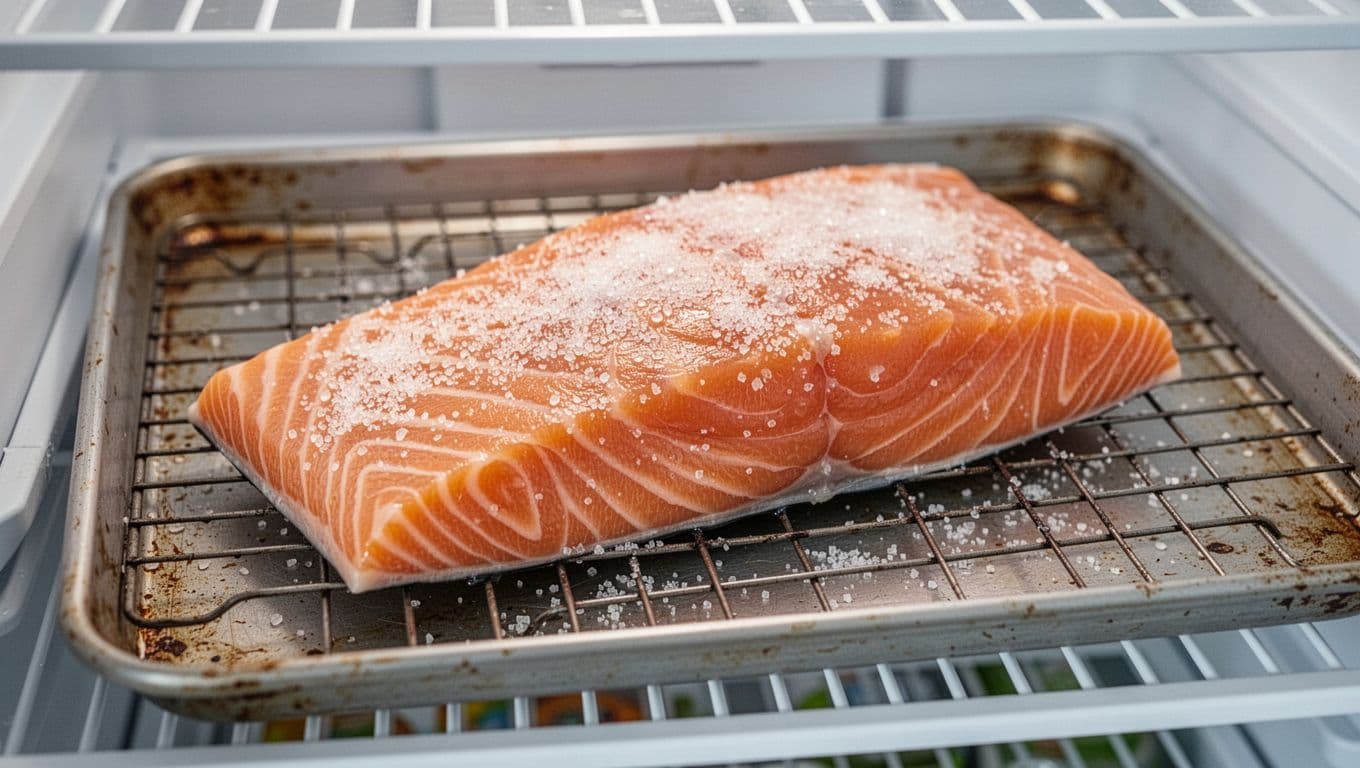
Blot thawed salmon with a clean paper towel. Excess surface moisture delays browning, which may tempt a cook to leave the fish on the heat after the center is done. If the fish was brined, label that step honestly and account for any salt already absorbed before seasoning.
Check early and in short intervals
Once salmon approaches the expected range, check every minute or two. A thin fillet can move from below the endpoint to overcooked quickly. Repeatedly opening an oven can slow cooking, so make each check deliberate.
Remove finished portions from residual heat
Move a finished fillet off the hot skillet, sheet pan, or grill zone. A metal pan continues transferring heat even after it leaves the burner or oven. Do not leave a 145°F fillet on a hot pan while waiting for the rest of the meal.
Match the method to the cut
Thicker center cuts tolerate roasting or grilling more evenly than very thin tails. Thin portions benefit from quicker methods and earlier checks. A glaze containing sugar can darken before the center is done, so use temperature—not surface color—to decide when to serve it.
Why common salmon tests fail
“It flakes, so it must be done”
Flaking is useful as a visual backup, but it does not provide a temperature. A fillet may begin separating before its thickest center reaches the safe endpoint. Verify 145°F whenever possible.
“The center feels warm against my lip”
Skin sensitivity is not calibrated to food temperature, and touching food to a lip can cause a burn. It can also spread raw seafood residue. Use a clean thermometer.
“It will rise exactly five degrees while resting”
There is no fixed carryover increase that applies to every fillet and method. A thin portion removed to a cool plate behaves differently from a thick portion left on a hot skillet. Do not remove the fish at 140–143°F and assume it will reach 145°F later.
“Sushi-grade salmon can be served at any temperature”
That phrase does not establish a universal regulatory safety standard or remove risks from undercooked seafood. This article’s cooked-salmon guidance remains 145°F.
“White albumin means the fish is ruined”
The white material that sometimes appears on salmon is coagulated protein. A large amount may accompany aggressive heat or extended cooking, but it does not tell you the precise center temperature. It is a quality observation, not a safety test.
Troubleshooting salmon doneness
The outside is done but the center is below 145°F
Lower the heat and continue gently. In an oven, loosely shield a very dark surface with foil while the center finishes. In a skillet, reduce the burner and cover briefly only if necessary; covering traps steam and softens a crisp surface. Recheck the center after a short interval.
Next time, choose portions of similar thickness and start at a slightly lower heat if the exterior browned far ahead of the center.
The thin end is dry before the thick end is done
Remove or shield the thin end. If cooking a whole side, fold an extremely thin tail underneath before cooking or separate it into a smaller portion that can leave the heat first. Do not keep the entire side cooking solely for the center cut.
The salmon breaks during temperature checking
Use a narrow probe and enter from the side. Support the fillet with a wide spatula when moving it. Natural flaking does not necessarily mean the fish is dry; judge dryness by its texture and avoid repeated probing.
The oven time was much longer than the table
Check the actual oven temperature, fillet thickness, whether the fish was frozen or thawed, and whether the pan was crowded. The table is an early-checking guide, not a guarantee.
Fresh, thawed, and frozen salmon
Store fresh or thawed seafood at 40°F or colder. FDA guidance advises using refrigerated seafood within two days after purchase or freezing it for longer storage.
Thaw frozen salmon in the refrigerator. For faster thawing, follow the same FDA guidance by sealing it in a plastic bag and submerging it in cold water, or microwave-defrost it only when it will be cooked immediately. Follow package instructions for vacuum-sealed fish; some products require removal from the packaging before thawing because reduced-oxygen packaging has specific handling risks.
Frozen salmon can be cooked without thawing, but it needs its own sequence and longer check window. MedlinePlus, for example, covers frozen portions before uncovering them for further baking. Do not represent a frozen method as interchangeable with the thawed timing table.
Storage and reheating
Refrigerate cooked salmon within two hours, or within one hour when the surrounding temperature is above 90°F. Put leftovers in shallow covered containers and keep the refrigerator at 40°F or below. Use refrigerated cooked leftovers within three to four days or freeze them within that period.
Reheat leftovers to 165°F in the thickest part. Gentle covered warming can help limit moisture loss, but it does not change the reheating endpoint. Reheat only the portion you plan to eat and avoid repeated heating and cooling.
Discard salmon that has remained at room temperature beyond the applicable limit. Smell and appearance cannot establish that improperly held leftovers are safe.
Related fish doneness guides
The same thermometer-first approach applies to other finfish, but their thickness and leanness change how quickly they dry out:
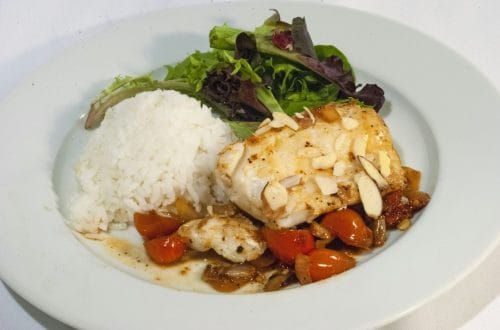
- How to know when tilapia is done without drying it out
- Mahi mahi temperature: how to tell when it is done and still moist
- How to tell when halibut is done and ready to serve
Use those pages for the fish named in each guide rather than carrying a salmon timing range over to a thinner or leaner species.