Family Recipe HQ • Kitchen guide
How to know when chicken wings are done: measure at least 165°F (74°C) in the thickest meat, away from bone, and check several flats and drumettes. Use skin texture to judge crispness only after the temperature check.
How to place a thermometer in a chicken wing
Wings are small, irregular, and surrounded by bone, so probe placement matters. A wide dial thermometer that must be inserted several inches may be too large for this job. A narrow-tip instant-read thermometer is generally easier to position in a flat or drumette.
Check a drumette
- Lift one of the larger drumettes with clean tongs and place it on a clean plate or hold it steady away from direct heat.
- Identify the thickest section of meat near the broad end.
- Insert the probe from the side so the sensing tip reaches the center of the meat.
- Stop before the tip touches bone.
- If the reading changes sharply when you adjust the angle, reposition the probe and check again.
Check a flat
A flat has less meat and two narrow bones. Insert a fine probe from the side into the thickest pocket of meat between the bones. Do not force the probe through to the other side. If the thermometer’s sensing area is too long for the flat, use the largest drumettes for initial checks and verify the flats with a thermometer designed for thin foods.
Check several pieces
Do not test only the largest-looking wing or the piece nearest the oven door. Check pieces from different parts of the pan, basket, fryer, or grill. Also check both flats and drumettes. Size, airflow, hot spots, and proximity to direct heat can make one piece reach 165°F before another.
If any checked piece is below 165°F, continue cooking that piece and other similarly sized wings. Recheck after a short interval. Do not average the readings; every wing served needs to reach the minimum.
For a complete pan setup, seasoning quantities, and oven timing, use the site’s crispy oven-baked chicken wings at 425°F recipe.
What wing temperatures actually mean
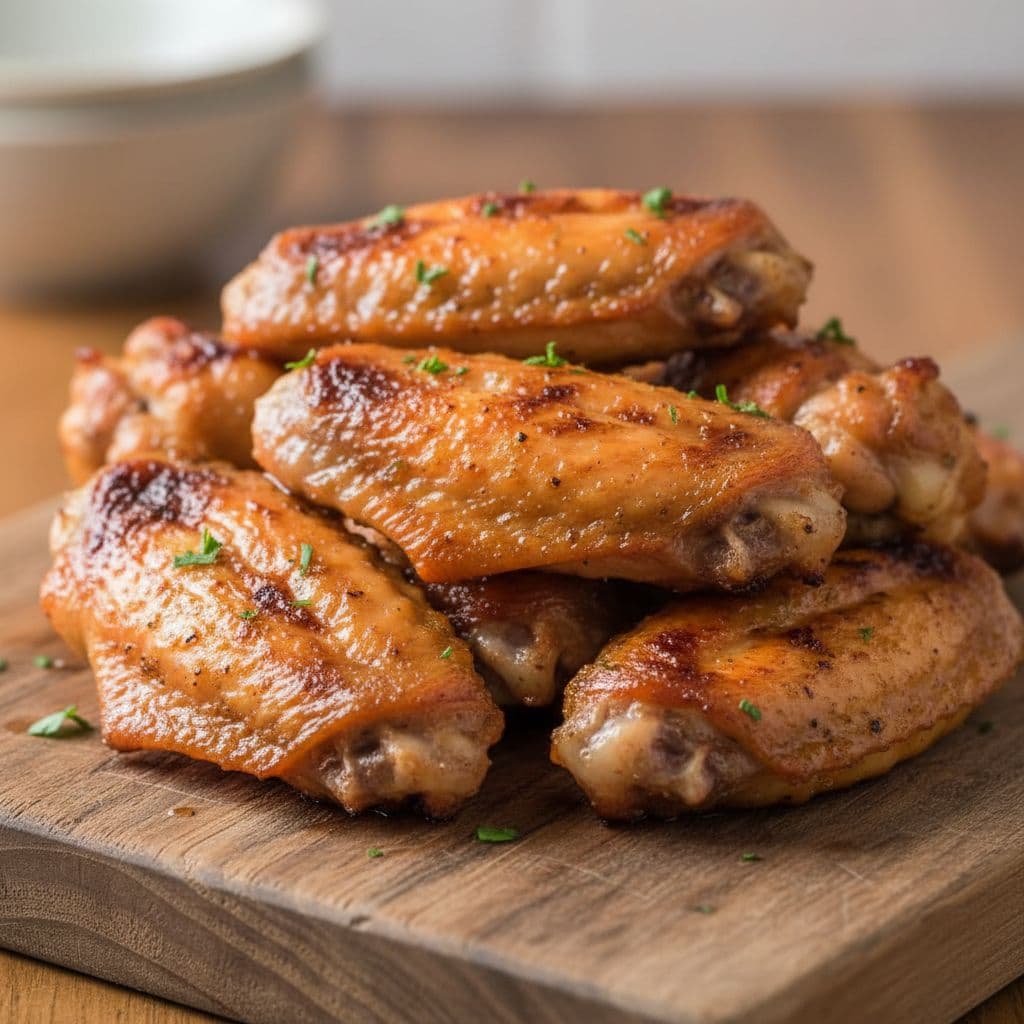
There is no single authoritative “best” temperature above 165°F that applies to every wing and cooking method. Some cooks prefer wings cooked beyond the minimum because additional heat can change the skin, fat, and connective tissue. That is a texture choice, not a second food-safety requirement.
| Measured temperature | What to do |
|---|---|
| Below 165°F | Continue cooking. Recheck the thickest meat away from bone. |
| 165°F or higher | The USDA minimum has been reached in that piece. Check several other wings before serving the batch. |
| Above 165°F | Further cooking is a texture decision. Watch closely for drying, burning, or scorched seasonings. |
Avoid treating 170°F, 180°F, 185°F, or 200°F as a universal target. A small flat under a broiler and a large drumette over indirect heat do not respond the same way. Probe position also has a larger effect in a small, bony piece than it does in a thick roast.
If the wings are safe but not crisp, focus on the surface instead of chasing a much higher internal number. Dry heat, airflow, space around the wings, and a short unsauced finish are more direct tools for improving the skin.
How to judge whether the skin is crisp
Crispness is a surface-quality judgment. It is not a safety test. Look for a combination of these signs after the wings have reached 165°F:
- the skin looks dry rather than wet or slick;
- rendered areas appear tightened against the meat;
- the surface is evenly browned without blackened spices or sugar;
- small blisters or lightly crackled edges are visible;
- the skin feels firm when handled with clean tongs;
- the wing does not release a cloud of trapped steam from crowded neighbors.
A loose joint or meat that pulls more readily from the bone can indicate a softer texture, but those cues should be evaluated only after the temperature check. They cannot replace it.
If the wings are safe but still pale
Keep the wings unsauced. Give them more space if they are crowded, then use the finishing step specified by your recipe. In an oven, that may mean moving the pan higher or broiling briefly. In an air fryer, it may mean a short additional interval in a single layer. On a grill, it may mean a brief move from indirect to direct heat.
Watch continuously during high-heat finishing. Small wings, paprika, sugar, and hot spots can move from browned to burnt quickly. Recheck any unusually large piece if the finishing step lasts more than a brief interval.
If the outside browns before the center reaches 165°F
Move the wings away from the most intense heat. In an oven, lower the rack or reduce the heat according to the recipe. On a grill, move them to the indirect zone and close the lid. In an air fryer, lower the temperature if the appliance allows and continue in short intervals.
Do not cover wings tightly unless the recipe calls for it; trapped steam can soften the skin. The goal is gentler cooking, not a sealed environment.
Why color and juices can mislead you
Poultry pigments do not change in one perfectly predictable way. Young chickens can show dark or pink areas near bone, and smoking or grilling can leave a pink tint even when the meat has exceeded 165°F. Freezing and processing can also affect appearance.
Clear-looking juices are not a thermometer reading. Neither is white meat. A wing can look pale or pink after reaching the minimum, and another can look opaque and browned while the center is still too cool.
Use appearance for these limited decisions:
- Is the skin browned enough for your preference?
- Does the surface look dry or steamed?
- Are sweet spices or sauce beginning to burn?
- Does the skin need a short, unsauced finish?
Use temperature for the safety decision.
If you are cooking a larger cut, thermometer placement changes. The site’s whole-chicken doneness guide explains the three locations that must be checked in a whole bird.
Common mistakes when checking wings
Touching the bone with the probe
A reading taken against bone may not represent the center of the meat. Reposition the probe into the thickest meat. Do not assume a bone-contact reading is always high or always low; treat it as unreliable.
Checking only one piece
Wings do not finish as a single unit. Check several pieces from different locations, especially when the batch contains both flats and drumettes.
Using a thermometer with an oversized sensing area
Read the manufacturer’s instructions. Some dial thermometers measure along a long section of the stem and cannot be positioned accurately in a thin wing. A narrow-tip instant-read model is more suitable.
Saucing before the skin is crisp
Sauce supplies moisture, and sugar can burn. Finish the cooking and crisping first, then toss the hot wings with sauce immediately before serving.
Cooking only for a darker color
Once the wings are safe, continued cooking may improve the surface for a short time, but it can also dry the meat or scorch the seasoning. Use a brief, controlled finishing step instead of chasing a fixed high internal temperature.
Relying on a universal time
Wings vary in size, starting temperature, spacing, and cooking method. A recipe’s time range tells you when to begin checking; it does not replace the thermometer.
Storage and reheating
Serve cooked wings promptly or keep them hot using suitable hot-holding equipment. Refrigerate leftovers in shallow containers within two hours. When the surrounding temperature is above 90°F, refrigerate them within one hour.
Use refrigerated cooked wings within three to four days. Reheat leftovers to 165°F, checking the thickest meat. Arrange wings in one layer when reheating so they warm evenly and have a better chance of regaining surface crispness.
Discard wings left at room temperature beyond the applicable time limit. Reheating does not reliably undo unsafe time-temperature handling.
Sources
Authoritative sources
- USDA-FSIS, Keep Your Chicken Wings in the Big Game
- USDA-FSIS, Food Thermometers
- USDA-FSIS, The Color of Meat and Poultry
- FoodSafety.gov, Safe Minimum Internal Temperatures
- USDA-FSIS, Keep Food Safe