Small pot · two bowls
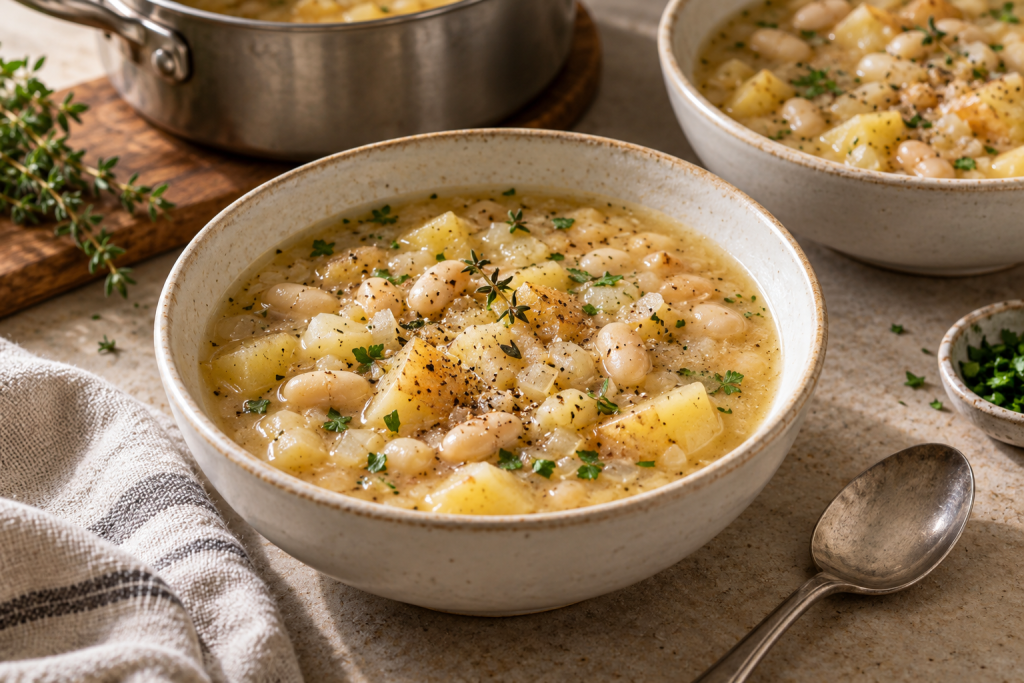
This small batch white bean potato soup without cream gets a lightly creamy body by mashing some of the cooked beans and potatoes directly in the saucepan. The deciding point is not a fixed number of mashes: cook the potato cubes until their centers crush easily, then stop mashing when the broth reaches the texture you want.
The quantities are designed for about two generous main-dish bowls, approximately 4 cups total. Because this recipe does not have a documented kitchen-test record, treat the 10-minute prep, 25–30-minute cook time, and 35–40-minute total time as estimates. Potato variety, cube size, burner output, and saucepan shape can change the timing; the tenderness check below is the reliable cue.
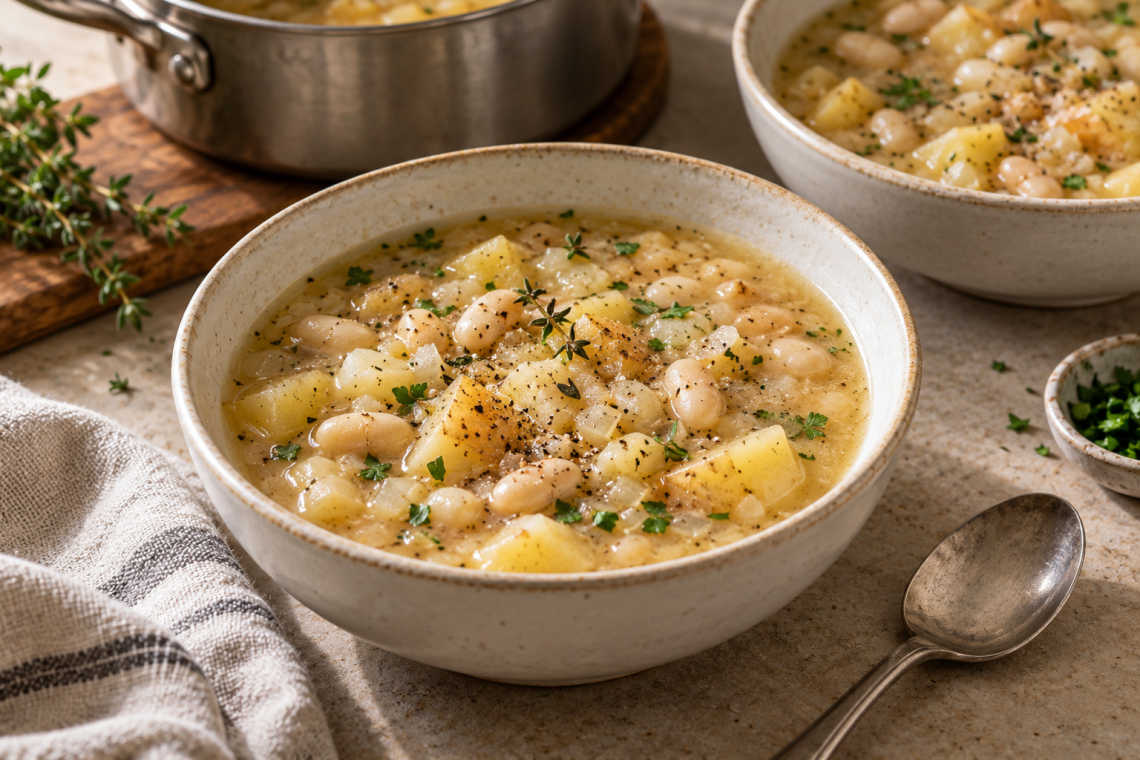
Featured photo: potato-soup serving reference by Thembi Johnson on Unsplash; it shows a different soup, not this white bean recipe.
At a glance
- Yield: 2 generous bowls, about 4 cups
- Prep: about 10 minutes
- Cook: about 25–30 minutes
- Total: about 35–40 minutes
Pan: 2- to 3-quart saucepan.
Small Batch White Bean Potato Soup Without Cream
Ingredients
- 1 tablespoon olive oil
- 1/2 medium onion, finely diced (about 1/2 cup)
- 2 garlic cloves, minced
- 12 ounces Yukon Gold potatoes, scrubbed and cut into 1/2-inch cubes
- 1 can (15 ounces) cannellini or Great Northern beans, drained and rinsed
- 2 1/2 cups low-sodium vegetable broth, plus up to 1/2 cup extra for adjusting texture
- 1/2 teaspoon dried thyme
- 1/4 teaspoon fine salt, plus more to taste
- 1/4 teaspoon black pepper
- 1 teaspoon lemon juice, plus more to taste
- Optional: 1 tablespoon chopped parsley for serving
Peeling the potatoes is optional. Scrub them thoroughly and trim damaged areas. Yukon Gold potatoes soften while holding recognizable pieces. Russets can supply more thickening, but their edges break down more readily. Great Northern and cannellini beans can be used interchangeably; dry beans are not a direct substitute because they require separate soaking or cooking.
Method
- Soften the onion. Warm the olive oil in a 2- to 3-quart saucepan over medium heat. Add the onion and cook for 5–6 minutes, stirring occasionally, until softened and translucent. Lower the heat if the onion starts browning quickly.
- Season the base. Stir in the garlic and thyme for about 30 seconds. Add the potatoes, drained beans, 2 1/2 cups broth, salt, and pepper. Gently scrape the bottom to release any softened onion.
- Cook to the center. Bring the pot to a gentle boil, then reduce it to a steady simmer. Cover partially and cook for about 15–20 minutes, stirring occasionally. Test one of the larger potato cubes rather than the smallest piece.
- Mash for body. When the tested potato crushes easily with a fork and has no firm center, remove the pan from the heat. Press a potato masher or sturdy fork through about one-third of the beans and potatoes. Stir before deciding whether to mash more.
- Balance the bowl. If the soup is thicker than you want, add extra broth 2 tablespoons at a time, up to the reserved 1/2 cup. Return it briefly to low heat if needed and stir across the bottom. Add the lemon juice, taste, and adjust salt and pepper. Ladle into bowls and add parsley if using.
Check tenderness before mashing. Do not mash by the clock alone. A fork should pass through the center of a larger potato cube without resistance, and the cube should crush without leaving a firm, grainy middle. If it does not, keep the soup at a steady simmer and test again after a few minutes.
Crushed beans and fully tender potatoes release enough starch to thicken the broth without cream, flour, or cornstarch. For other recipes where potatoes and beans are not available, see how to thicken soup without flour or cornstarch.
Mash safely in a small saucepan
Remove the pan from the heat and set it on a stable surface. If your masher barely fits, lift a small portion of the tender beans and potatoes into a heatproof bowl with a slotted spoon. Mash with a little broth from the soup, then return it to the pot. Use a utensil suitable for your pan’s coating and work slowly to avoid splashing hot liquid.
Stir before deciding whether to mash more. When serving, alternate scoops between the bowls so both receive whole beans and potato pieces.
Choose the finish before you mash
| Finish | What to mash | Final adjustment |
|---|---|---|
| Brothy and chunky | Press only a few beans and potato cubes | Leave the remaining pieces intact; add no extra broth unless needed |
| Lightly creamy | Mash about one-third of the beans and potatoes | Stir, wait a minute, then add broth only if the soup is thicker than you want |
| Thicker bowl | Mash a little beyond one-third, stopping before all the pieces disappear | Keep the heat low and loosen with broth 2 tablespoons at a time |
You can always mash more, but you cannot restore whole pieces. The soup also thickens slightly between the stove and the table, so make the last texture adjustment after stirring the mashed portion back through the pot.
Read the symptom, then make one correction
| Symptom | Likely issue | Action |
|---|---|---|
| Watery after mashing | Too little of the beans and potatoes were crushed, or the pot retained more liquid | Mash a little more, stir, and wait one minute. If still thin, simmer uncovered for a few minutes while stirring frequently. |
| Potatoes remain firm | Cubes are larger than 1/2 inch, or the pot is below a steady simmer | Maintain small regular bubbles and continue cooking. Add the lemon only after the potatoes are tender. |
| Soup catches on the bottom | The thickened soup is over higher heat or has not been stirred across the base | Lower the heat and add a splash of broth. If scorched, move the unburned soup to a clean pan without scraping up the scorched layer. |
| Soup tastes too salty | The broth or canned beans supplied more sodium than expected | Add unsalted broth in small amounts, understanding that it will thin the texture. Start with low-sodium broth and make the final salt adjustment only after mashing. |
Scaling and serving boundaries
For four servings, double every ingredient and use a 4- to 5-quart pot. Keep the potato cubes at 1/2 inch. A larger batch will take longer to come to a simmer, so do not simply double the clock time; use the fork-tender checkpoint. Mash conservatively, stir, and reassess before pressing more.
For a different herb profile, replace the thyme with 1/2 teaspoon dried Italian seasoning. A small pinch of smoked paprika can add warmth, but avoid adding unmeasured grains or thickeners because they would change the liquid requirement. Serve the soup with toast or a simple green salad. For a small pot with a chewier grain texture, try small-batch mushroom barley soup without wine.
Cool, store, and reheat safely
Transfer leftovers to shallow containers and refrigerate within 2 hours, or within 1 hour when the surrounding temperature is above 90°F. Keep them at 40°F or below and use within 3–4 days. Reheat leftovers to 165°F, stirring so the center heats evenly; for stovetop reheating, USDA guidance also calls for bringing soups to a rolling boil. See the USDA leftovers and food safety guidance.
The soup will thicken in the refrigerator. During reheating, add broth 1 or 2 tablespoons at a time rather than pouring in the full reserved amount. Freezing is possible, but thawed potato pieces may be softer or grainier; mashing those pieces into the broth can make that texture less noticeable.
Printable recipe
Print the measured ingredients and step-by-step instructions using the recipe card below.
THE COMPLETE RECIPE
Small Batch White Bean Potato Soup Without Cream
Yield: 2 generous bowls (about 2 cups each)
Ingredients
- 1 tablespoon olive oil
- 1/2 medium onion Finely diced, about 1/2 cup.
- 2 cloves garlic Minced.
- 12 ounces Yukon Gold potatoes Scrubbed and cut into 1/2-inch cubes; peeling optional.
- 1 15-ounce can cannellini or Great Northern beans Drained and rinsed.
- 2 1/2 cups low-sodium vegetable broth Plus up to 1/2 cup extra for adjusting texture.
- 1/2 teaspoon dried thyme
- 1/4 teaspoon fine salt Plus more to taste.
- 1/4 teaspoon black pepper
- 1 teaspoon lemon juice Plus more to taste.
- 1 tablespoon chopped parsley Optional, for serving.
Equipment
- 1 2- to 3-quart saucepan with lid
- 1 potato masher or sturdy fork
- 1 Knife and cutting board
- 1 Measuring cups and spoons
- 1 ladle
Instructions
- Soften the onion. Heat olive oil in the saucepan over medium heat. Add onion and cook for 5–6 minutes, stirring occasionally, until softened and translucent. Reduce the heat if it starts browning quickly.
- Build the soup. Stir in garlic and thyme for about 30 seconds. Add potatoes, drained beans, 2 1/2 cups broth, salt, and pepper. Gently scrape the bottom to release any softened onion.
- Simmer until the potatoes are tender. Bring to a gentle boil, then reduce to a steady simmer. Partially cover and cook for about 15–20 minutes, stirring occasionally. Test one of the larger potato cubes: it should crush easily with a fork with no firm center. Continue simmering if needed.
- Mash for body. Remove the saucepan from the heat and set it on a stable surface. Carefully mash about one-third of the beans and potatoes with a potato masher or sturdy fork. Stir before deciding whether to mash more. If the masher does not fit comfortably, transfer a small portion to a heatproof bowl, mash with a little soup broth, and return it to the pot. Avoid splashing hot liquid.
- Adjust and serve. If the soup is too thick, add extra broth 2 tablespoons at a time, up to the reserved 1/2 cup. Return briefly to low heat if needed, stirring across the bottom. Add lemon juice, taste, and adjust salt and pepper. Divide between bowls and add optional parsley.
Notes
Rate This Recipe
Made this recipe? Choose a star rating in the comment form and share how it turned out. Your cooking time and any ingredient changes can help the next reader.
Rate This Recipe