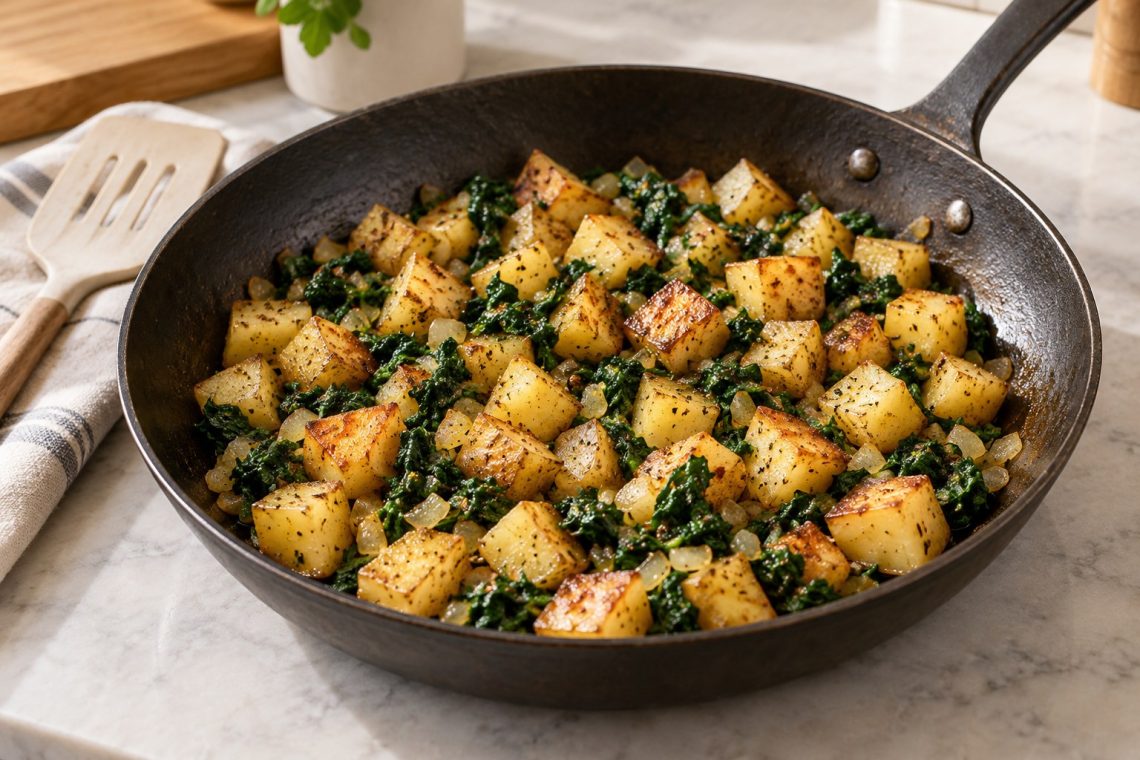
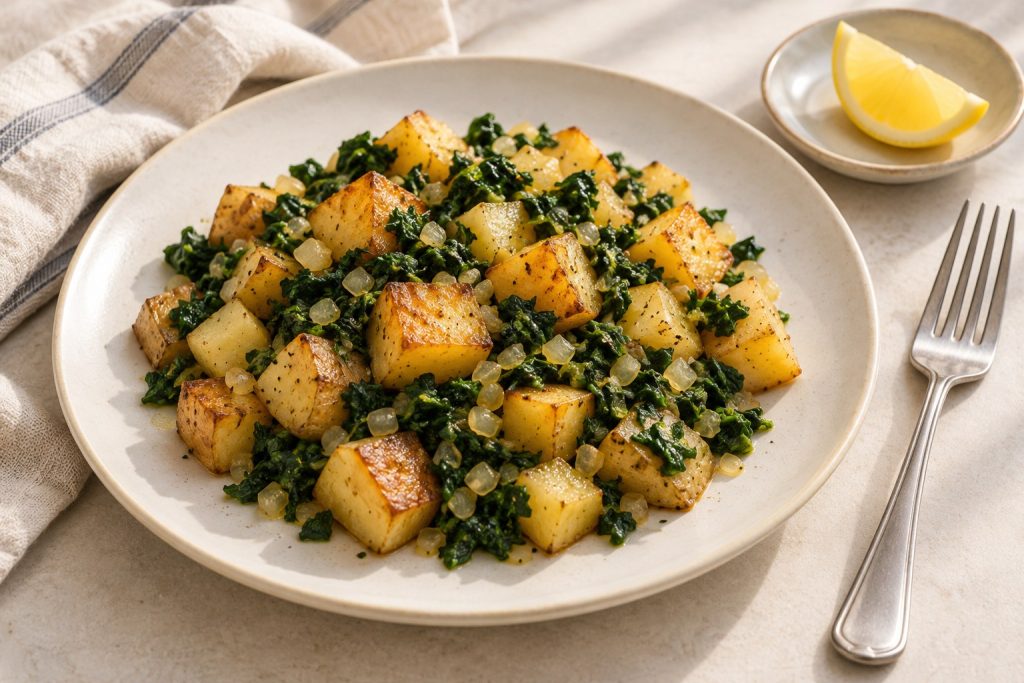
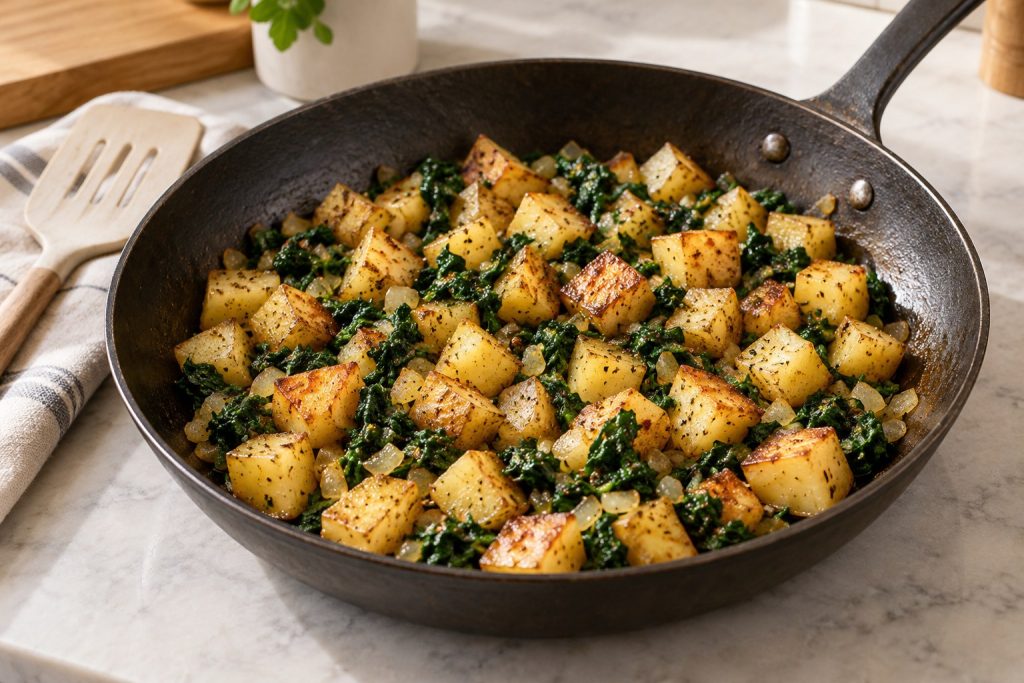
This potato spinach breakfast hash combines golden potato cubes, chopped spinach and softened onion in one skillet, with no eggs required. A short covered steam helps the potato centers cook through; uncovered cooking then dries the pan and browns the surfaces. The spinach goes in near the end so it does not leave the potatoes sitting in green liquid.
The recipe uses one medium Yukon Gold potato and a measured portion of frozen chopped spinach. It makes one large breakfast portion or two modest sides, with smoked paprika, garlic and a little lemon for flavor.
Recipe at a glance
- Yield
- 1 large breakfast portion or 2 side portions.
- Preparation
- about 10–15 minutes, including cooking and draining the spinach.
- Skillet cooking
- about 20–30 minutes.
- Total
- about 30–45 minutes; allow extra time if the potato centers need more steaming.
- Equipment
- a 10-inch skillet with a fitted lid, a spatula, a knife and board, measuring tools, and a colander or clean kitchen towel for draining spinach.
A 10-inch nonstick or well-seasoned skillet is useful for this small amount: most cubes can touch the pan without being piled up. Keep the heat moderate and use a utensil suitable for your pan’s surface.
Ingredients for potato spinach breakfast hash
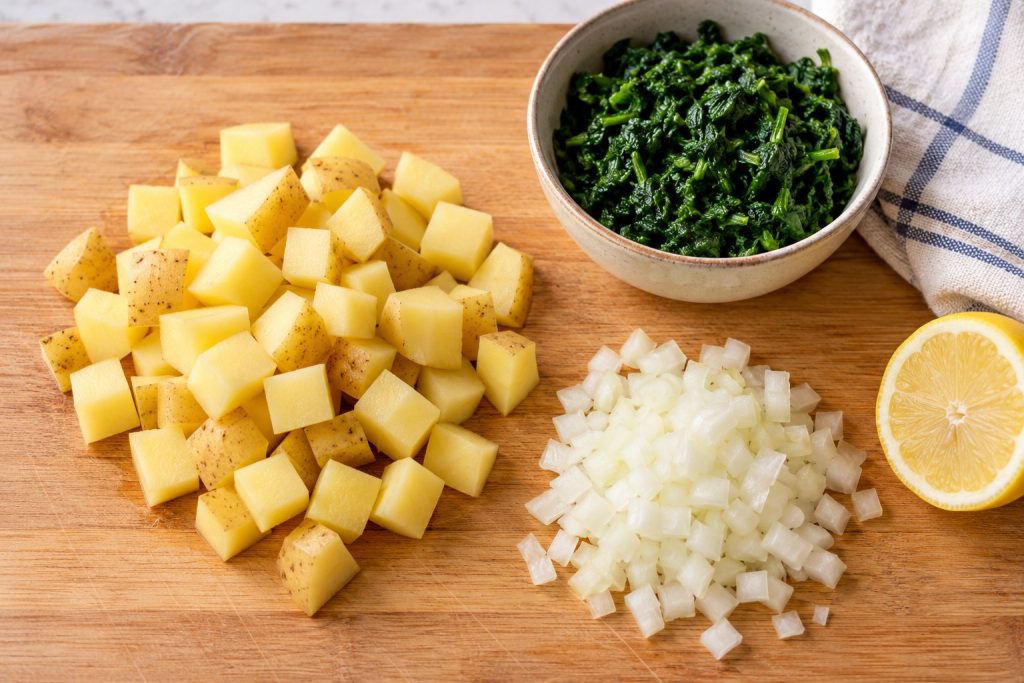
- 1 medium Yukon Gold potato, 7–8 ounces (200–225 g), scrubbed and cut into 1/2-inch cubes
- 3/4 cup plain frozen chopped spinach, loosely measured from a bag before cooking, then cooked according to its package instructions and drained very well
- 1/2 small yellow onion, diced, about 1/3 cup
- 1 tablespoon olive oil, divided into 2 teaspoons and 1 teaspoon
- 2 tablespoons water, plus 1 tablespoon more if needed during steaming
- 1/4 teaspoon garlic powder
- 1/4 teaspoon smoked paprika
- 1/4 teaspoon fine salt, plus more only after tasting
- 1/8 teaspoon black pepper
- 1 teaspoon lemon juice
Choose plain spinach rather than creamed or seasoned spinach. The potato weight is more useful than the word “medium,” since a much larger potato crowds the skillet and needs additional cooking. Peeling a Yukon Gold is optional; scrub it well if keeping the skin.
Prepare the frozen spinach before starting the skillet
The 3/4-cup measure assumes loose chopped frozen spinach from a bag, not a solid frozen block. Spoon the loose pieces into the cup without packing them down, before they shrink from cooking and draining. Follow the package’s cooking directions, including any minimum temperature or standing time. A defrost cycle alone is not a substitute for the package’s cooking step.
Drain the cooked spinach in a colander, then let it cool just enough to handle safely. Press it firmly with a spoon, or squeeze it in a clean kitchen towel, until it no longer drips freely. Break apart the compressed greens so they can be scattered through the potatoes. The drained portion will look much smaller than the original frozen measure; that is expected.
This preparation matters for a frozen spinach breakfast hash because excess liquid keeps the potato surfaces wet. Cook and drain the spinach first, then add it after the potatoes have browned.
How to make the breakfast hash without eggs
- Prepare the vegetables. Cook and drain the spinach as described above. Scrub the potato, cut it into even 1/2-inch cubes and pat the cut surfaces dry. Dice the onion. Measure the seasonings so they are ready for the last stage.
- Start the potatoes, about 4 minutes. Heat 2 teaspoons olive oil in the skillet over medium heat. Add the potato cubes in one layer. Leave them undisturbed for about 2 minutes, then turn and cook for another 2 minutes. A few pale golden faces are enough now; they do not need to be cooked through yet.
- Soften the onion, about 2–3 minutes. Add the diced onion and remaining teaspoon of oil. Stir occasionally until the onion starts to turn translucent. Lower the heat if it darkens quickly. Save the garlic powder and paprika for later.
- Cover and steam, about 6–8 minutes. Reduce the heat to medium-low. Carefully add 2 tablespoons water around the potatoes and cover with the lid. Stir once halfway through. At about 6 minutes, test the largest cube with the tip of a small knife: it should enter with only slight resistance. If the pan is dry and the center is still firm, add the extra tablespoon of water, cover for 2 more minutes and check again.
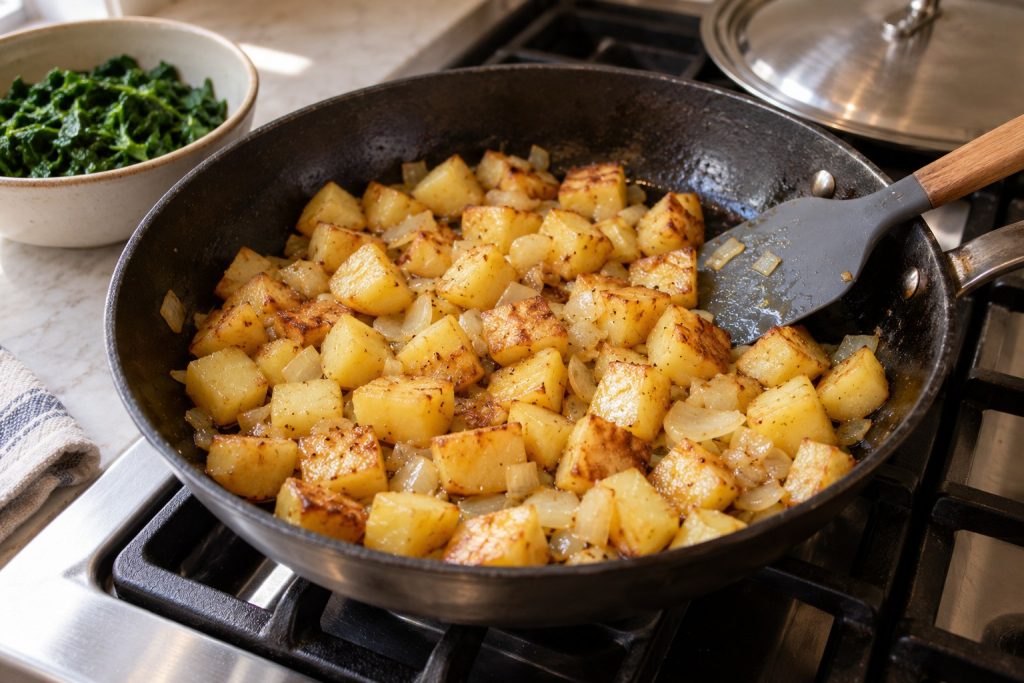
- Uncover, dry and brown. Remove the lid and return to medium heat. Let any visible water evaporate, usually about 1–2 minutes. Spread the potatoes back into a single layer and cook for about 3–5 minutes, turning only occasionally, until several faces have golden patches. If the center is still hard, return to the covered step before trying to brown further.
- Add the seasonings and spinach. Lower the heat slightly. Sprinkle in the garlic powder, smoked paprika, salt and pepper; stir for about 20 seconds, then immediately fold in the cooked, well-drained spinach. Cook for about 2–3 minutes, breaking up clumps, until the spinach is evenly hot and the skillet has no pooled liquid.
- Check and finish. The largest potato cube should cut easily with a fork, with no hard or chalky center. Take the skillet off the heat, add the teaspoon of lemon juice, taste, and adjust the seasoning if needed. Serve promptly for the best contrast between tender centers and browned edges.
How to get tender centers and browned edges
Keep the two cooking stages distinct
The covered stage traps moisture while the centers soften. Once the potatoes are nearly tender, remove the lid so that moisture can escape. Trying to brown potatoes while water is still pooled in the pan prolongs the cooking without improving their surface texture.
Covered cooking followed by releasing steam is also used in Washington State University Extension’s skillet potatoes and greens recipe. Its batch and cuts differ; use the knife and fork checks here to judge this smaller hash.
Give each potato face contact with the pan
After steaming, spread the cubes out and let them sit between turns. Constant stirring moves each piece away from the cooking surface before it can brown. Several golden sides are sufficient; chasing a dark crust on every face can overcook the onion and break the potato cubes.
Add powdered spices near the end
Garlic powder and paprika need only a brief stir before the spinach is added. Putting them in during the first sear exposes them to the entire cooking time and makes scorching more likely. If the pan is very hot after browning, lower the heat and let it settle before adding the spices.
Troubleshooting a wet or unevenly cooked hash
| Problem | Useful correction |
|---|---|
| Brown outside, firm inside | Lower the heat, add 1 tablespoon water and cover for about 2 minutes. Retest the center before returning to uncovered browning. |
| Tender but pale potatoes | Let visible moisture evaporate, spread the cubes into one layer and leave them still for a few minutes over medium heat. |
| Green liquid pools after adding spinach | Cook uncovered until the liquid evaporates. Drain and press the spinach more thoroughly next time; extra oil will not remove water. |
| Only a few cubes stay hard | The cuts may be uneven. Give the larger pieces more covered cooking and use the largest cube as your doneness check. |
| Paprika or garlic tastes bitter | Scorched spice cannot be undone. Add it after browning, keep that step brief and reduce the heat before the spinach goes in. |
On a small screen, scroll the table sideways to see every column.
Substitutions and scaling
Other potatoes
Red potatoes or russets can be used at the same 7–8 ounce weight and 1/2-inch cut. Red potatoes tend to keep a firmer shape; russets can develop softer, more crumbly edges. Check the largest piece rather than assuming each variety finishes on an identical schedule.
Fresh spinach
For a version with fewer greens, use about 2 packed cups of fresh baby spinach. This is a lighter substitution, not an exact volume equivalent to the frozen amount. Wash it unless the package says it is ready to eat, dry it well, and add it by handfuls after the potatoes brown. Cook until wilted and any released liquid has evaporated.
Seasoning changes
Use the same amount of regular paprika for a less smoky flavor. A small pinch of dried thyme or cumin can be added with the other spices. Keep additions modest in a one-potato batch, and taste before adding extra salt.
Making breakfast for two
For two larger portions, double the ingredients and use a wider skillet that still fits the potatoes in a single layer, or cook two batches. A deep pile of cubes traps steam and limits browning. Keep the same cut size and check tenderness; extra ingredients do not mean every cooking time should double.
Serving ideas
Serve the hash as soon as it is ready. Toast, fruit or a side of beans can make it a fuller breakfast. The base recipe uses olive oil and plain vegetables, so eggs and dairy are unnecessary; check any packaged seasonings or accompaniments if you have specific dietary needs.
For another egg-free breakfast, try FRHQ’s make-ahead breakfast quesadillas without eggs. If you have more frozen spinach to use, couscous with canned lentils and frozen spinach offers another pantry meal.
Make-ahead, storage and reheating
For a quicker start, dice the onion and refrigerate it in a covered container. You can also cook and drain the spinach ahead, refrigerate it promptly, and use it when making the hash. Cut the potato just before cooking, or cook the whole hash and refrigerate the finished meal.
Refrigerate cooked food in shallow containers within 2 hours, or 1 hour if the surroundings are above 90°F (32°C). Keep it at 40°F (4°C) or below. Use leftovers within 3–4 days and reheat to 165°F (74°C), following USDA’s leftovers guidance. If the spinach was cooked ahead, count storage time from that first cooking.
Reheat the hash in a lightly oiled skillet over medium heat, spreading it into a thin layer and turning it so the center heats through. A brief covered start can help if it is refrigerator-cold; uncover afterward to let moisture escape. A microwave also reheats it, but will not restore crisp edges. Check the temperature instead of judging safety by browning alone.
Common questions
Do I need to boil the potato first?
No separate boiling step is needed for this method. The measured water and fitted lid provide a steaming stage in the same skillet. Continue that stage if the largest cube is still hard inside.
Can I add frozen spinach straight to the potatoes?
For this recipe, cook it according to its package directions and drain it first. Adding a frozen block directly changes the moisture and timing, and can leave some greens cold while the potato edges overcook.
Does hash need an egg to hold together?
No. This is a loose skillet mixture, so no binder is needed. Serve the potato cubes, onion and spinach together as they come from the pan.
Can I leave out the lemon?
Yes. It finishes the flavor but does not cook or bind the potatoes. Taste the hash without it first, then adjust pepper or seasoning if needed.
Printable recipe
Print the measured ingredients and step-by-step instructions using the recipe card below.
THE COMPLETE RECIPE
Potato Spinach Breakfast Hash Without Eggs
Yield: 1 large breakfast portion (or 2 side portions)
Ingredients
- 1 medium Yukon Gold potato 7–8 ounces (200–225 g), scrubbed and cut into 1/2-inch cubes; peeling is optional.
- 3/4 cup plain frozen chopped spinach Loosely measure from a bag before cooking; cook according to the package and drain very well.
- 1/2 small yellow onion Diced, about 1/3 cup.
- 1 tablespoon olive oil Divided: 2 teaspoons for the potatoes and 1 teaspoon for the onion.
- 2 tablespoons water Plus 1 tablespoon more if needed during steaming.
- 1/4 teaspoon garlic powder
- 1/4 teaspoon smoked paprika
- 1/4 teaspoon fine salt Plus more only after tasting.
- 1/8 teaspoon black pepper
- 1 teaspoon lemon juice
Equipment
- 1 10-inch skillet with fitted lid Nonstick or well-seasoned; use utensils suited to the pan.
- 1 Spatula
- 1 Knife and cutting board
- Measuring cups and spoons
- 1 colander or clean kitchen towel For draining the cooked spinach.
Instructions
- Prepare the vegetables. Loosely measure the frozen chopped spinach before cooking. Cook according to its package directions, including any minimum temperature and standing time; defrosting alone is insufficient. Drain in a colander, let cool enough to handle, then press firmly with a spoon or squeeze in a clean kitchen towel until it no longer drips freely. Break apart the greens. Scrub the potato, cut into even 1/2-inch cubes, and pat the surfaces dry. Dice the onion and measure the seasonings.
- Start the potatoes, about 4 minutes. Heat 2 teaspoons olive oil in the skillet over medium heat. Add the potato cubes in one layer. Leave them undisturbed for about 2 minutes, then turn and cook for another 2 minutes. A few pale golden faces are enough now; they do not need to be cooked through yet.
- Soften the onion, about 2–3 minutes. Add the diced onion and remaining teaspoon of oil. Stir occasionally until the onion starts to turn translucent. Lower the heat if it darkens quickly. Save the garlic powder and paprika for later.
- Cover and steam, about 6–8 minutes. Reduce the heat to medium-low. Carefully add 2 tablespoons water around the potatoes and cover with the lid. Stir once halfway through. At about 6 minutes, test the largest cube with the tip of a small knife: it should enter with only slight resistance. If the pan is dry and the center is still firm, add the extra tablespoon of water, cover for 2 more minutes and check again.
- Uncover, dry and brown. Remove the lid and return to medium heat. Let any visible water evaporate, usually about 1–2 minutes. Spread the potatoes back into a single layer and cook for about 3–5 minutes, turning only occasionally, until several faces have golden patches. If the center is still hard, return to the covered step before trying to brown further.
- Add the seasonings and spinach. Lower the heat slightly. Sprinkle in the garlic powder, smoked paprika, salt and pepper; stir for about 20 seconds, then immediately fold in the cooked, well-drained spinach. Cook for about 2–3 minutes, breaking up clumps, until the spinach is evenly hot and the skillet has no pooled liquid.
- Check and finish. The largest potato cube should cut easily with a fork, with no hard or chalky center. Take the skillet off the heat, add the teaspoon of lemon juice, taste, and adjust the seasoning if needed. Serve promptly for the best contrast between tender centers and browned edges.
Notes
Rate This Recipe
Made this recipe? Choose a star rating in the comment form and share how it turned out. Your cooking time and any ingredient changes can help the next reader.
Rate This Recipe