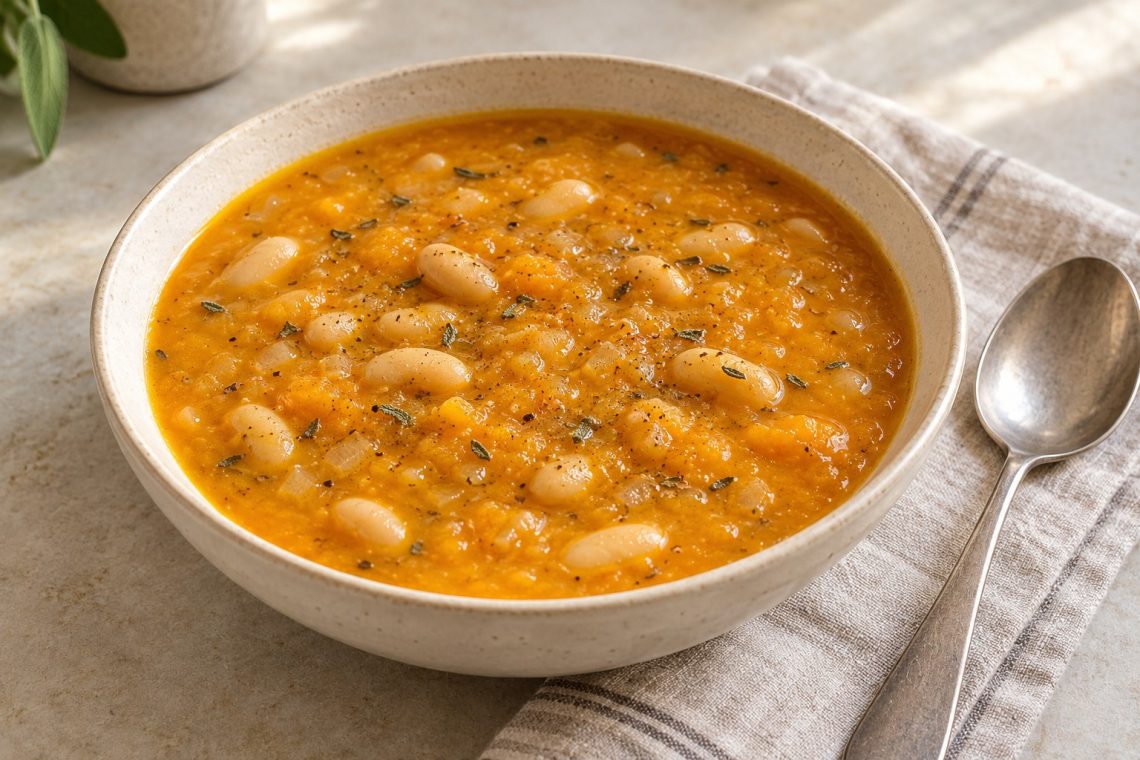
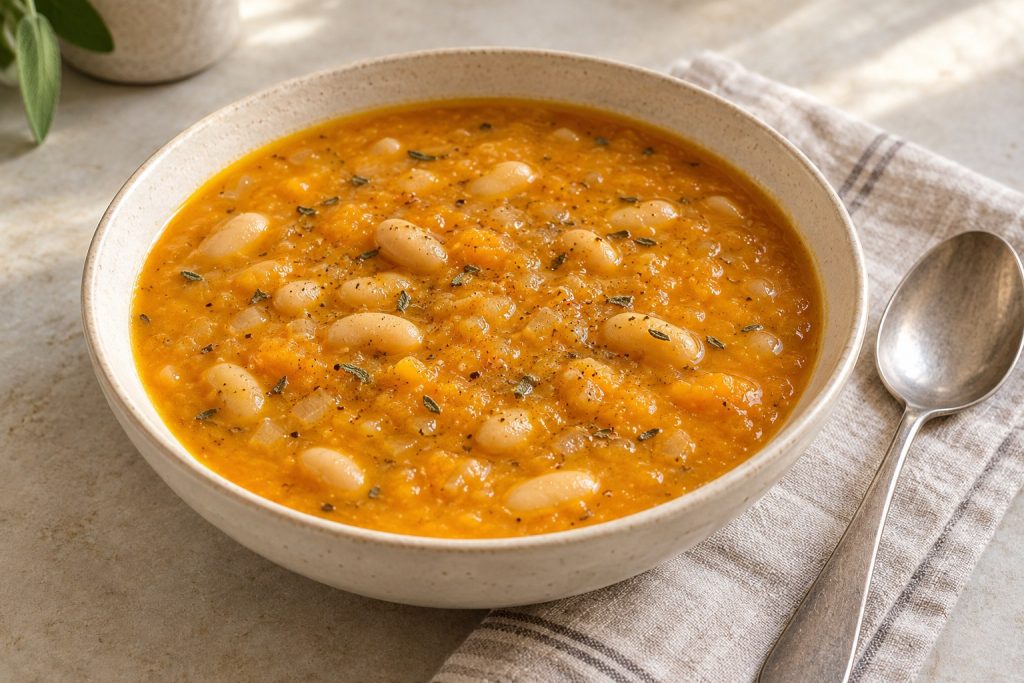
Pumpkin white bean soup combines a smooth pumpkin base with tender whole beans, onion, garlic, and a little sage. It has a creamy texture without milk or cream, and a small addition of cider vinegar keeps the finish savory and bright.
This small batch uses plain canned pumpkin and one can of white beans. A saucepan and fork are enough: the pumpkin is already puréed, and mashing a portion of the beans gives the broth more body. Allow about 30–35 minutes, then serve with toast or a salad for two.
Recipe note: This research-informed recipe has not yet been kitchen-tested by Family Recipe HQ. Cooking times and serving yield are estimates; use the texture cues below to guide adjustments.
Pumpkin white bean soup with sage: ingredients and timing
- Estimated yield
- 2 main-dish bowls
- Preparation
- About 10 minutes
- Cooking and finishing
- About 20–25 minutes
- Total time
- About 30–35 minutes
Equipment: A 3-quart saucepan, knife, cutting board, can opener, measuring cups and spoons, stirring spoon, ladle, and sturdy fork or potato masher. A small heatproof bowl is helpful for mashing the beans. A very wide pan will lose liquid faster than a saucepan, so watch the consistency as it simmers.
Measured ingredients
- 1 tablespoon olive oil
- 1/3 cup finely diced yellow onion, approximately 1/2 small onion
- 1 medium garlic clove, minced
- 1/4 teaspoon dried rubbed sage
- 3/4 cup plain canned pumpkin purée, not pumpkin pie filling
- 1 can (15 ounces) great northern beans, drained and rinsed
- 1 3/4 cups low-sodium vegetable broth, divided, plus extra only if needed for thinning
- 1/4 teaspoon ground black pepper
- 1 teaspoon apple cider vinegar, plus more to taste
- Up to 1/4 teaspoon fine salt, added gradually only if needed
- Optional for serving: toast, toasted pumpkin seeds, or a small drizzle of olive oil
Measure before cooking: Reserve 1/2 cup of the broth for loosening the pumpkin; the remaining 1 1/4 cups goes in with the beans. These amounts add up to the listed 1 3/4 cups. The 15-ounce can weight includes packing liquid: use the drained contents of one can, not 15 ounces of drained beans. Measure the onion after dicing because onion sizes vary.
How to make the soup
- Prepare everything first. Dice the onion finely, mince the garlic, and drain and rinse the beans. Let excess rinse water drip away. Measure the pumpkin, sage, and broth before turning on the burner so the garlic will not be left frying while you open a can.
- Soften the onion. Warm the oil in the saucepan over medium heat for about 1 minute. Add the onion and cook for 5–6 minutes, stirring regularly, until soft and translucent. Lower the heat if the edges brown quickly or begin to stick.
- Add garlic and sage. Stir in the garlic and dried rubbed sage for about 30 seconds, just until fragrant. Keep them moving across the pan; the garlic should not turn dark brown.
- Loosen the pumpkin. Add the pumpkin and black pepper and stir for about 30 seconds. Gradually stir in the reserved 1/2 cup broth, scraping across the base and into the corners, until the pumpkin disperses evenly. This makes it easier to remove dense lumps before the pan is full.
- Add the beans and remaining broth. Stir in the drained beans and remaining 1 1/4 cups broth. Allow approximately 3–4 minutes to reach a simmer, then reduce the heat so small bubbles rise steadily.
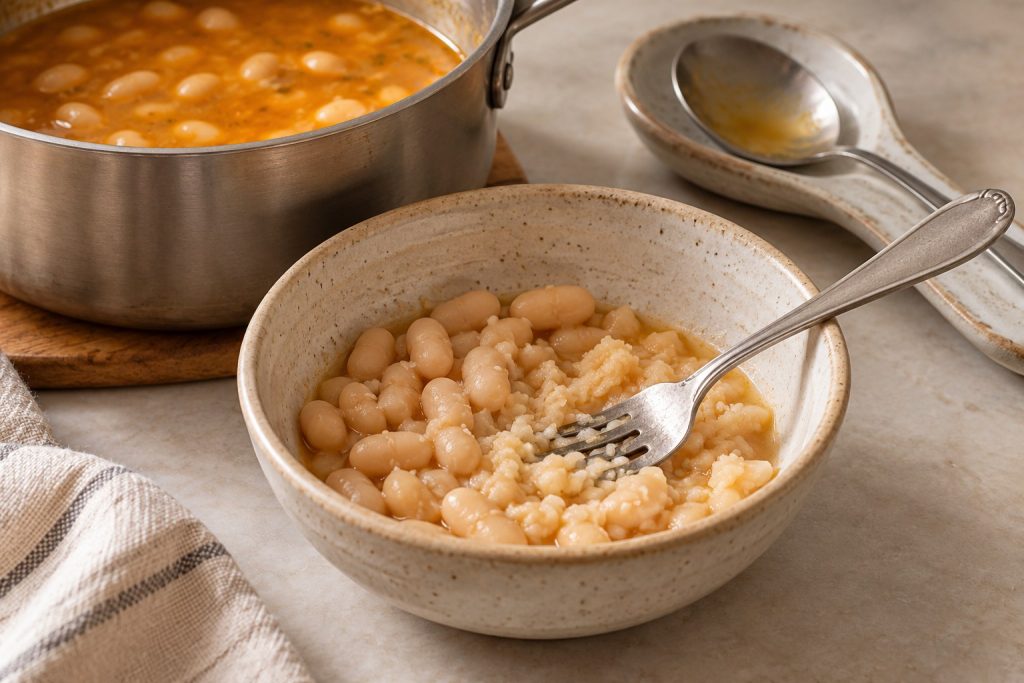
- Simmer and check the body. Cook uncovered for 8–10 minutes, stirring along the bottom occasionally. The onion should be fully soft and the beans hot throughout. For a thicker broth, lift about 1/2 cup of beans into a heatproof bowl, mash them with a fork and a spoonful of liquid from the pot, and stir them back in. Use less if the soup is already thick enough.
- Finish off the heat. Stir in 1 teaspoon cider vinegar. Taste a cooled spoonful containing beans and broth. Add salt in small pinches only if needed, up to the listed 1/4 teaspoon. If it is seasoned but still tastes heavy, add more vinegar in 1/4-teaspoon increments, tasting between additions.
- Adjust and portion. The soup should flow from the ladle while carrying whole beans. If it is too thick, stir in extra warm broth 2 tablespoons at a time and taste again. Stir from the bottom before dividing between two bowls so each portion receives both beans and pumpkin broth.
Choose the right pumpkin, beans, and sage
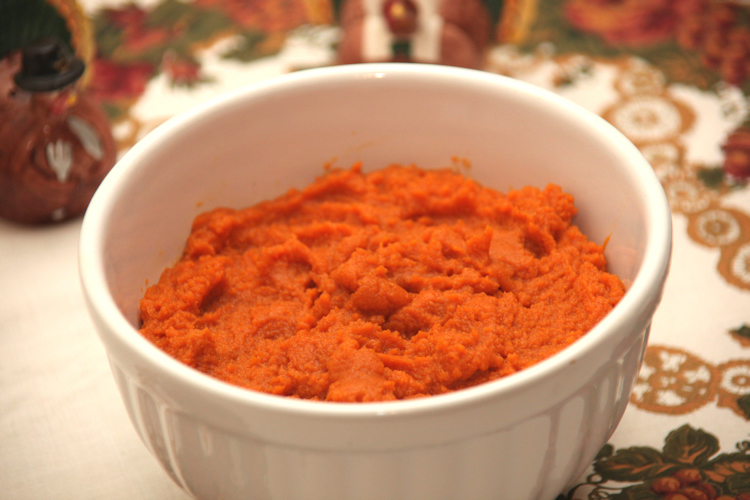
Use plain pumpkin purée
Check for plain pumpkin or 100% pumpkin on the label. Pumpkin pie filling is a different product: for example, Libby’s describes its pie mix as containing sugar and spices. Those additions change the flavor of a savory soup. Measure a level 3/4 cup instead of adding the whole can.
Homemade purée is a possible variation if it is fully cooked and smooth. Use the same 3/4-cup volume, but assess its thickness first. For a watery purée, hold back about 1/4 cup of the final broth addition and add it only if needed. Raw pumpkin cubes require a different cooking method and are not a direct swap for the purée.
White beans determine how much mashing you need
Great northern beans are the base choice. Cannellini or navy beans can replace them using one drained 15-ounce can. Softer beans may thicken the soup with less mashing, while firmer beans leave a more distinct bite. Check a bean before deciding to crush the full 1/2 cup.
Draining and rinsing gives you more control over the broth’s saltiness and thickness. If you have beans cooked from dry, use approximately 1 1/2 cups drained, fully tender beans as a starting substitution, following Camellia’s general canned-to-cooked bean conversion. Dried beans themselves need separate preparation; the short simmer here is for already-cooked beans.
Fresh, rubbed, and ground sage need different measures
The base recipe uses 1/4 teaspoon dried rubbed sage. If using another form, these are starting amounts based on Nebraska Extension’s general herb-substitution ratios; herb strength still varies.
| Sage form | Starting amount for this batch | How to add it |
|---|---|---|
| Dried rubbed sage | 1/4 teaspoon | Add with the garlic as written |
| Fresh sage | 3/4 teaspoon finely chopped leaves | Remove tough stems, chop finely, and add with the garlic |
| Finely ground dried sage | 1/8 teaspoon | Measure lightly and stir in with the garlic |
On a small screen, scroll the table sideways to see every column.
Fresh leaf size varies, so a measured amount is more useful than a leaf count. Let the soup simmer before judging the herb level. If you want more sage, add only a small pinch and simmer briefly before tasting again.
Why pumpkin soup without cream can still be creamy
Pumpkin supplies the smooth base, while mashed beans give it more body. Leaving most beans whole creates a soup with contrasting textures. There is no flour slurry or separate dairy substitute to prepare.
For a looser soup, leave the beans whole and add warm broth gradually. For more thickness, mash an additional 1/4 cup of beans and simmer for about 2 minutes before deciding whether it needs more. That optional adjustment adds a little time beyond the basic method.
Check the texture after mashing and seasoning. Soup that sits in a mound needs liquid; soup that pours easily can still feel substantial because of the beans. Extra broth dilutes the seasoning, so taste after thinning. Our guide to thickening soup without flour or cornstarch explains other approaches.
Troubleshooting flavor and consistency
The soup tastes flat or overly sweet
Taste a cooled spoonful. If it needs seasoning, add a small pinch of salt. If there is enough salt but the pumpkin tastes heavy or overly sweet, try 1/4 teaspoon cider vinegar. Stir and taste after each change. More sage does not solve every flavor problem, and adding several seasonings at once makes it harder to judge the result.
The soup is too thick, too thin, or sticking
Thin thick soup with warm broth in 2-tablespoon additions. If it is thin, mash some beans before increasing the heat. A hard boil encourages splashing and can let the pumpkin catch on the bottom; gentle heat and a spoon passed across the whole pan base are more useful.
The sage or garlic tastes bitter
Extra unsalted broth may soften an overly strong herb flavor, but it will also thin the soup. Burned garlic or a scorched base is harder to correct. Remove the pan from the heat and transfer the unaffected soup to a clean pan without scraping up the burned layer. Taste before continuing; if the burned flavor has spread throughout, adding vinegar or sugar is unlikely to rescue it.
Serving ideas and practical variations
Serve pumpkin white bean soup with crisp toast, a sandwich, or a green salad. Toasted pumpkin seeds add crunch, and an olive-oil drizzle adds richness. Keep crunchy toppings separate until the bowls reach the table.
To keep it dairy-free or vegan: choose suitable vegetable broth and check bread, croutons, and other packaged toppings. The base contains no milk or cream. For another acid: try lemon juice or white wine vinegar in small additions off the heat, tasting as you go; they give a different finish from cider vinegar.
For a larger batch: a proportional doubling is a starting point for four estimated servings. That means 1 1/2 cups pumpkin, two 15-ounce cans of beans, and 3 1/2 cups broth, with the other ingredients doubled too. Use a larger pot if needed and allow more time to reach a simmer. Keep the onion and bean doneness cues; doubling the ingredients does not double each cooking stage.
For another pantry meal, explore our bean and lentil recipe collection.
Storage, freezing, and reheating
Divide leftovers into shallow containers and refrigerate promptly, within 2 hours or within 1 hour above 90°F. Keep the refrigerator at 40°F or below, following FDA storage guidance. Do not wait for the whole saucepan to cool on the counter.
Use refrigerated soup within 3–4 days. For longer storage, freeze portions in suitable containers with expansion room. FoodSafety.gov lists 2–3 months as a general freezer-quality guideline for soups; thawed texture may differ from a fresh batch.
Thaw in the refrigerator. Reheat the portion you need, adding a little broth or water if it has thickened. Stir thoroughly, heat leftovers to 165°F, and bring soup to a rolling boil as advised by Nebraska Extension. Stir carefully to limit splashing.
Frequently asked questions
Can I make it without a blender?
Yes. Canned pumpkin is already puréed. A sturdy fork or potato masher is enough for the small portion of beans that thickens the broth; leave the rest whole.
What should I do with the rest of the canned pumpkin?
Transfer it to a covered food-storage container, refrigerate promptly, and follow the product’s after-opening directions. Label the amount and date. Measuring the remainder also helps you decide whether you have enough for another batch without opening a second can.
Can I make the soup ahead for lunch?
Yes, provided it is cooled and stored as above. Pack toppings separately. Reheat with enough broth or water to restore a pourable consistency, then taste before adding more vinegar or salt. If making two portions for one person, put the second portion into its shallow storage container when you serve the first.
Printable recipe
Print the measured ingredients and step-by-step instructions using the recipe card below.
THE COMPLETE RECIPE
Pumpkin White Bean Soup with Sage (No Milk or Cream)
Yield: 2 main-dish bowls (estimated)
Ingredients
- 1 tablespoon olive oil
- 1/3 cup yellow onion Finely diced, approximately 1/2 small onion.
- 1 medium clove garlic Minced.
- 1/4 teaspoon dried rubbed sage
- 3/4 cup plain canned pumpkin purée Not pumpkin pie filling.
- 1 15-ounce can great northern beans Drained and rinsed; use the drained contents of one can.
- 1 3/4 cups low-sodium vegetable broth Divided: 1/2 cup to loosen the pumpkin and 1 1/4 cups with the beans; extra only if needed for thinning.
- 1/4 teaspoon ground black pepper
- 1 teaspoon apple cider vinegar Plus more to taste in 1/4-teaspoon additions.
- 1/4 teaspoon fine salt Use up to this amount, added gradually only if needed.
- toast, toasted pumpkin seeds, or olive oil Optional, for serving.
Equipment
- 1 3-quart saucepan
- 1 Knife and cutting board
- 1 can opener
- Measuring cups and spoons
- 1 stirring spoon and ladle
- 1 sturdy fork or potato masher
- 1 small heatproof bowl For mashing a portion of the beans.
Instructions
- Prepare everything first. Dice the onion finely, mince the garlic, and drain and rinse the beans. Let excess rinse water drip away. Measure the pumpkin, sage, and broth before turning on the burner so the garlic will not be left frying while you open a can.
- Soften the onion. Warm the oil in the saucepan over medium heat for about 1 minute. Add the onion and cook for 5–6 minutes, stirring regularly, until soft and translucent. Lower the heat if the edges brown quickly or begin to stick.
- Add garlic and sage. Stir in the garlic and dried rubbed sage for about 30 seconds, just until fragrant. Keep them moving across the pan; the garlic should not turn dark brown.
- Loosen the pumpkin. Add the pumpkin and black pepper and stir for about 30 seconds. Gradually stir in the reserved 1/2 cup broth, scraping across the base and into the corners, until the pumpkin disperses evenly. This makes it easier to remove dense lumps before the pan is full.
- Add the beans and remaining broth. Stir in the drained beans and remaining 1 1/4 cups broth. Allow approximately 3–4 minutes to reach a simmer, then reduce the heat so small bubbles rise steadily.
- Simmer and check the body. Cook uncovered for 8–10 minutes, stirring along the bottom occasionally. The onion should be fully soft and the beans hot throughout. For a thicker broth, lift about 1/2 cup of beans into a heatproof bowl, mash them with a fork and a spoonful of liquid from the pot, and stir them back in. Use less if the soup is already thick enough.
- Finish off the heat. Stir in 1 teaspoon cider vinegar. Taste a cooled spoonful containing beans and broth. Add salt in small pinches only if needed, up to the listed 1/4 teaspoon. If it is seasoned but still tastes heavy, add more vinegar in 1/4-teaspoon increments, tasting between additions.
- Adjust and portion. The soup should flow from the ladle while carrying whole beans. If it is too thick, stir in extra warm broth 2 tablespoons at a time and taste again. Stir from the bottom before dividing between two bowls so each portion receives both beans and pumpkin broth.
Notes
Rate This Recipe
Made this recipe? Choose a star rating in the comment form and share how it turned out. Your cooking time and any ingredient changes can help the next reader.
Rate This Recipe