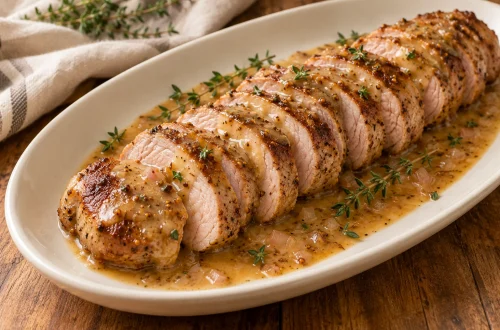
Golden crust · Generous sauce
Pork Chops with Maple Mustard Sauce
Golden edges, a bright maple pan sauce, and a dinner worth setting the table for.
- Total time
- 40–45 min
- Serves
- 4 people
- The method
- Sear + roast
- The finish
- Maple + Dijon
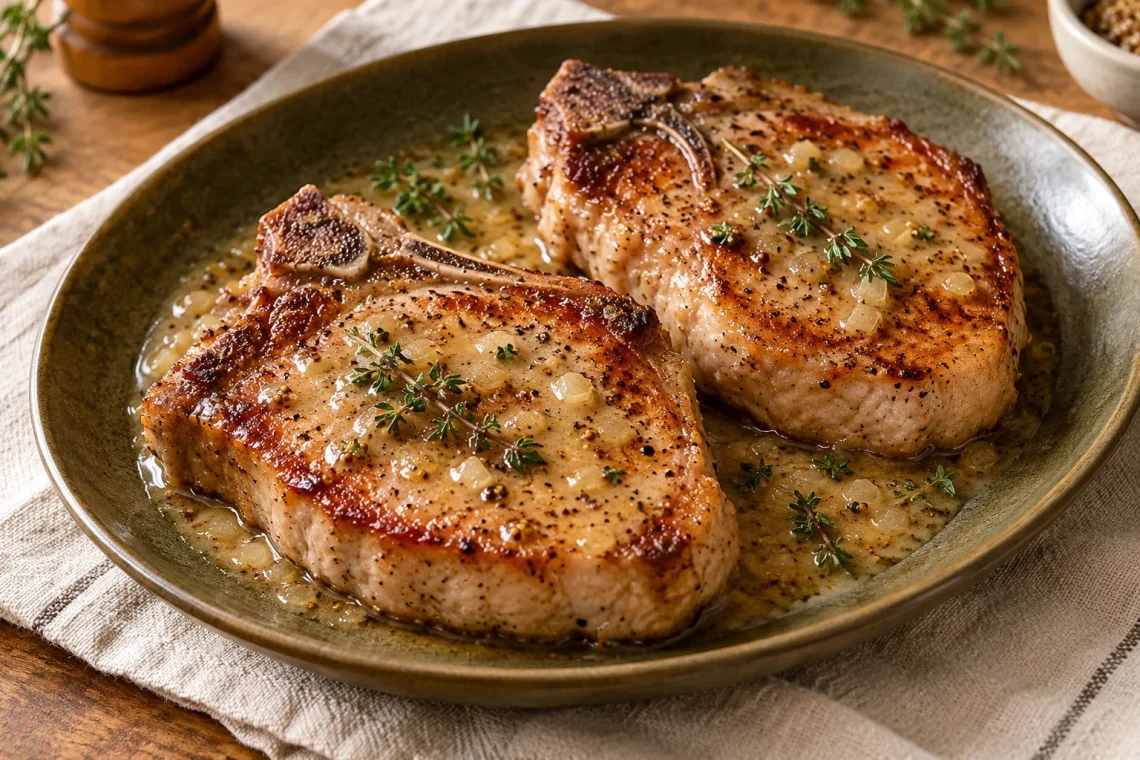
Bring pork chops with maple mustard sauce to the table on warm plates, with a golden crust still visible beneath a glossy spoonful of sauce. The maple softens the mustard’s edge, while cider vinegar and thyme keep the finish savory. It is a generous dinner without a long ingredient list.
The method gives each part its own moment: brown the chops in batches, finish them together in the oven, and make the sauce in the skillet. A thermometer and a little attention to timing matter more than elaborate preparation.
At the butcher counter and in the pantry
For pork chops with maple mustard sauce, choose four bone-in, center-cut chops about 1 inch thick and 8 ounces each. Similar thickness helps them cook at a similar pace. Avoid assuming that two chops weighing the same will finish together; their shape matters too.2
- Plain pork: Check for added seasoning or brine. Reduce the recipe’s salt if the chops are already salted.
- Pure maple syrup: This supplies the main sweet flavor. Pancake syrup produces a different result.
- Two mustards: Dijon gives a smooth base; whole-grain mustard adds small, pleasant bursts of texture.
- Unsalted broth: Useful for controlling seasoning because mustard already contributes salt.
- Fresh shallot and thyme: These give the sauce a savory background without a heavy coating of spices.
Measure the mustards and vinegar before cooking. Tasting and adding freely at the stove can work for a large pot, but this small sauce changes quickly with an extra spoonful. Keep additional broth nearby for thinning, and save any final salt adjustment until the sauce has reduced.
Keeping maple out of the searing pan also makes heat easier to manage. The chops can brown without a sugary coating darkening first. Once broth enters the skillet, the syrup can join the sauce and simmer gently while you control its final consistency.
Let thickness guide your attention
| Your cut | How to approach it |
|---|---|
| Bone-in, about 1 inch | The intended cut for this recipe. Check each chop separately. |
| Boneless, about 1 inch | It can work, but begin checking earlier; follow temperature rather than the estimated oven time. |
| Thin or unusually thick | Use a cooking schedule suited to that thickness. Keep this sauce as the finishing element. |
Use fully thawed chops for the method below. Pat their surfaces dry so they begin browning promptly when they meet the pan.
If the package contains a noticeably thinner chop, put it where you can reach it easily for checking. When buying from a butcher counter, ask for even thickness across the set rather than focusing only on the total weight.
The golden-crust method for pork chops with maple mustard sauce
Phase one · Give the crust some space
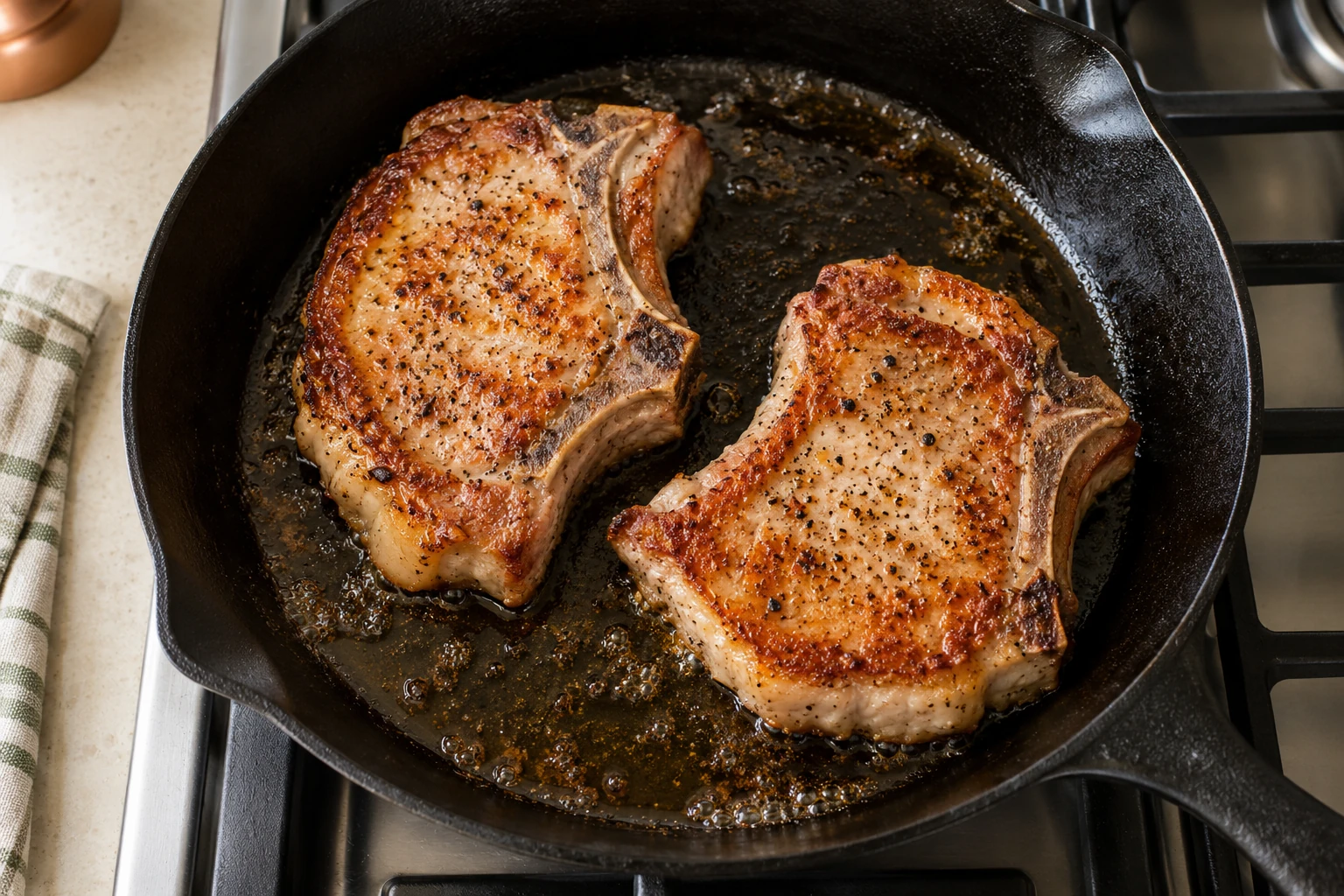
Heat the oven to 400°F (200°C). Season the dry chops with salt and pepper. Heat a little of the measured oil in a heavy skillet over medium-high heat. Sear two chops at a time for 2–3 minutes per side, adding the remaining oil for the second batch as needed.
Transfer each batch to a rimmed baking sheet. After the second batch is seared, immediately put the sheet in the oven. Crowding four large chops into the skillet makes it harder to brown them evenly. Watch the deposits in the pan: brown is useful; black and acrid means the heat was too high.
Give the first side uninterrupted contact with the skillet. Constant lifting prevents you from seeing how steadily it is browning. Use tongs to turn the chop gently, and lower the heat if the edges darken before the broad surface colors.
Phase two · Finish by temperature
Start checking after 6 minutes in the oven. Around 6–12 minutes is an estimate, depending on thickness and the sear. Insert the thermometer from the side into the center of the meat, avoiding the bone.
Remove each chop only when it reaches at least 145°F. Transfer to a clean platter and rest at least 3 minutes; plan on 5. One chop may finish before another, so check all four.1
Phase three · Finish pork chops with maple mustard sauce
While the chops roast, lower the skillet to medium-low. Soften the minced shallot for 2–3 minutes, then stir in garlic for 30 seconds. Add broth and scrape up the brown deposits. Whisk in maple syrup, both mustards, vinegar and thyme.
Simmer gently for 3–5 minutes, stirring, until lightly spoon-coating. Take off the heat and whisk in optional butter. Add the rested chops’ juices, taste, and thin with broth if needed. Spoon over the rested chops; avoid simmering them in the sauce while everyone finds a seat.
A sauce with sweetness, sharpness and restraint
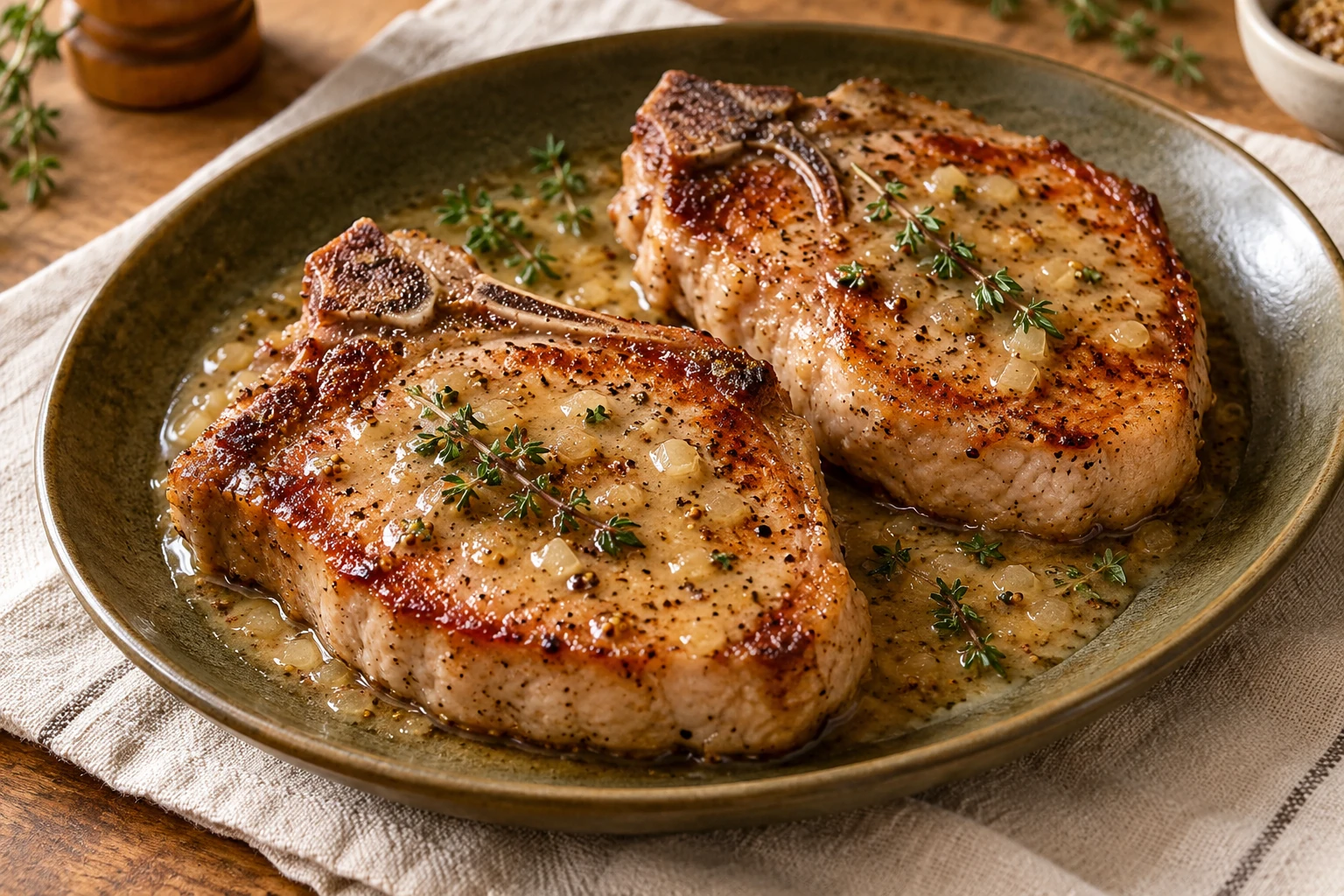
Taste pork chops with maple mustard sauce as a complete bite. A sauce that seems assertive on its own may be just right alongside the meat. Aim for a glossy coating that moves across the plate.
The finished sauce should leave some browned surface visible. Spoon it over part of each chop, rather than covering everything. If it becomes syrupy while waiting, a little warm broth restores a looser texture. Recheck the flavor after thinning, because dilution softens both sweetness and seasoning.
| If it tastes or looks… | Try this |
|---|---|
| Too sweet | Add cider vinegar in ½-teaspoon increments. |
| Too sharp | Add maple syrup in ½-teaspoon increments. |
| Too thick | Whisk in warm broth, 1 tablespoon at a time. |
| Too thin | Simmer briefly without the chops, checking often. |
| Scorched | Start the sauce in a clean pan; sweetness will not remove bitterness. |
Set the table while the oven works
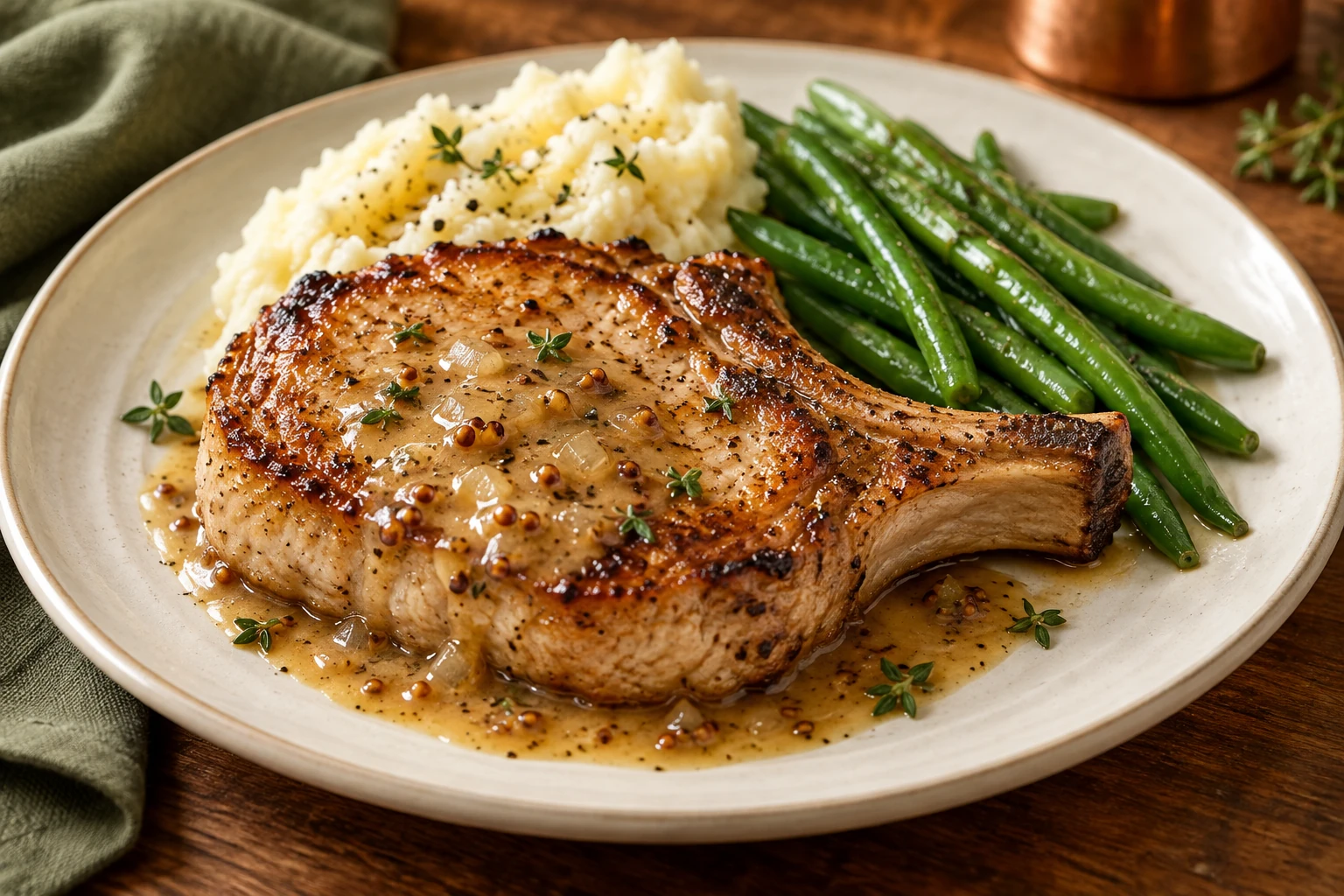
For an inviting plate of pork chops with maple mustard sauce, choose one soft side and one fresh contrast. Mashed potatoes catch the sauce; green beans or a crisp cabbage salad bring a different texture. Keep additional sweet glazes off the vegetables so the main course stays balanced.
For an easy side, see our guide to cooking rice, then choose a mild variety that leaves the mustard sauce in focus.
Budget about 40–45 minutes: roughly 10 for preparation, 25 for cooking and 5 for resting, with the sauce made during roasting and resting. Start any slower side first. Put warm plates, serving spoons and a small sauce jug on the table before the chops leave the oven.
For a relaxed gathering, serve the sides in shared bowls and plate the chops individually. This keeps the main course looking tidy while allowing guests to choose their portions. A few fresh thyme leaves are enough garnish; the mustard seeds already give the sauce visual detail.
Small changes for a different evening
Add a pinch of cayenne for warmth, replace thyme with ½ teaspoon finely chopped rosemary, or omit the optional butter for a lighter finish. For smoother sauce, replace the whole-grain mustard with Dijon, then taste before adding extra vinegar.
To make pork chops with maple mustard sauce for eight, double the ingredients and use two baking sheets. Sear in manageable batches and check every chop. More meat needs more pan space and preparation time, not automatically twice the oven time.
A thoughtful plan for tomorrow
Refrigerate leftovers in shallow covered containers within 2 hours, or within 1 hour if the surroundings exceed 90°F. Keep the refrigerator at 40°F or below and use within 3–4 days. Freeze promptly if keeping longer.5
Reheat a portion with a little broth in a covered skillet or microwave-safe dish. Check that it reaches 165°F.1 For a different meal, serve reheated slices over rice with a quick vegetable sauté, adding only enough sauce to moisten the bowl.
Before you put on the apron
Must I marinate the chops?
No. This method gets its flavor from seasoning, browning and the finished sauce. Measuring ingredients beforehand is more useful than squeezing in a short marinade.
Why did the chops turn dry?
Overcooking is one likely cause. Check each chop early, remove it when it reaches the safe endpoint, and avoid leaving it in a bubbling sauce afterward.
Can I judge doneness by color?
Use the thermometer. Exterior browning and the shade of the center cannot replace the temperature-and-rest checkpoint.
Can I prepare anything ahead?
Measure the sauce ingredients and mince the shallot earlier in the day. Refrigerate perishable ingredients separately from raw pork. Cook the chops close to serving.
What if I only have salted broth?
Use it, but reduce the salt on the pork slightly and avoid seasoning the sauce until the end. If the broth is especially salty, replace part of it with water. Taste before making further adjustments.
A cooking sequence for four chops and one skillet
The practical challenge in this dinner is coordinating two searing batches, one oven finish, and a sauce that needs only a few minutes. Prepare the next landing place before moving the current batch. This keeps the cooking session continuous and gives you room to check each chop separately.
Before the first batch
Put a rimmed baking sheet beside the stove and a separate clean serving platter nearby. The sheet receives partially cooked pork; the platter is for chops that have reached their safe endpoint. Do not swap those roles without cleaning the surface. Measure the sauce ingredients and set out the thermometer before heating the skillet.
Compare the four chops. A thinner one should be easy to reach when you begin temperature checks. Pat each surface dry, season as directed, and divide the measured oil between the two batches. Keep unused raw chops refrigerated until the cooking session is ready to proceed.
Between the two searing batches
Transfer the first pair directly to the baking sheet and continue immediately with the second pair. Give the skillet enough time to regain useful heat, watching the browned deposits closely. Add the remaining oil as needed to maintain a thin film. A smoking pan or blackening deposits are reasons to lower the heat, not to hurry the next pair into it.
This brief wait belongs to one continuous cooking session. Do not partially cook chops, refrigerate them, and plan to finish them later. Once both batches are seared, put the sheet straight into the preheated oven and set a timer for the first check.
While the oven finishes the centers
Lower the skillet heat before adding the shallot. If the deposits are black and acrid, use a clean pan for the sauce rather than scraping them into the broth. Keep the sauce at a gentle simmer and pause that work whenever the timer calls for a temperature check.
Insert the probe from the side toward the center of each chop, avoiding bone and the hot sheet. Check from a second angle if the reading seems inconsistent. Remove each chop only when it reaches at least 145°F, then rest it for at least three minutes; the recipe plans for five.
If the sauce is ready before the pork
Take the sauce off strong heat so it does not keep reducing. Cover or hold it gently as appropriate for the short remaining cook, and whisk in a little warm broth if it thickens. Add the pork’s collected resting juices after the meat has rested, then taste before any final adjustment.
Keep the chops out of the skillet while fixing the sauce. A small change in vinegar or maple can happen without reheating the meat. When the balance is right, spoon sauce over one part of each chop and offer the remainder separately.
FAQ: What if the fat edge makes a chop curl?
First check that the chop lies reasonably flat before cooking and use tongs to position it carefully. Avoid pressing repeatedly on the center while it cooks. If the cut has a tight outer band, ask the butcher about trimming it when buying the chops; a reasonably even cut is easier to sear.
FAQ: Can I make dinner for two?
Halve the ingredients and use two chops of the same stated thickness. You may need only one searing batch, but the center temperature and rest requirement stay the same. A smaller sauce quantity can reduce faster, so watch its consistency rather than using the full simmer time automatically.
FAQ: Can I freeze the finished sauce separately?
You can portion cooled sauce for freezing alongside a safe leftover-storage plan, but thawed sauce may need gentle whisking and a little broth. Label and date the container, thaw in the refrigerator, and reheat leftovers to 165°F. Keep sauce separate from the meat if you want more control over reheating.
For pork chops with maple mustard sauce, the smoothest finish comes from keeping three tasks distinct: sear for flavor, verify the center for doneness, and adjust the sauce with the pork resting nearby. That sequence makes a four-person dinner easier to manage without rushing the last few minutes.
The finishing touch
Pork chops with maple mustard sauce deserve a few quiet minutes at the end: let the meat rest, taste the sauce, and give each plate a measured spoonful. Keep the remaining sauce nearby. That small bit of care brings the crust, the savory meat and the maple together.
Sources and further reading
Government sources support the temperature and storage guidance. The cooking references provided comparison reading for the sear-and-roast approach and maple mustard pairing; this article’s composition and sauce formulation are original.2, 3, 4
Made this recipe? Leave a star rating and share how it turned out.
Pork Chops with Maple Mustard Sauce
Ingredients
Equipment
Method
- Heat the oven to 400°F (200°C). Pat thawed chops dry and season both sides with salt and pepper. Measure the sauce ingredients and set out a rimmed baking sheet.
- Heat part of the tablespoon of oil in a heavy skillet over medium-high heat. Sear two chops for 2–3 minutes per side. Transfer to the sheet. Repeat with the remaining chops and oil, reducing heat if deposits darken too quickly.
- Immediately put the sheet in the oven after the second batch. Begin checking each chop after 6 minutes; allow approximately 6–12 minutes, guided by temperature. Insert the thermometer into the center, away from bone. Each chop must reach at least 145°F before removal.
- Transfer cooked chops to a clean platter. Cover loosely and rest at least 3 minutes; plan on 5 minutes. Remove individual chops as they become ready.
- Lower the skillet to medium-low. Add the extra teaspoon oil if dry. Soften shallot for 2–3 minutes; stir in garlic for 30 seconds. Add broth and scrape up brown deposits. Whisk in syrup, both mustards, vinegar and thyme. Simmer gently for 3–5 minutes until lightly spoon-coating.
- Off heat, whisk in optional butter and resting juices. Thin with broth if needed, then spoon over the rested chops. Keep extra sauce at the table.