
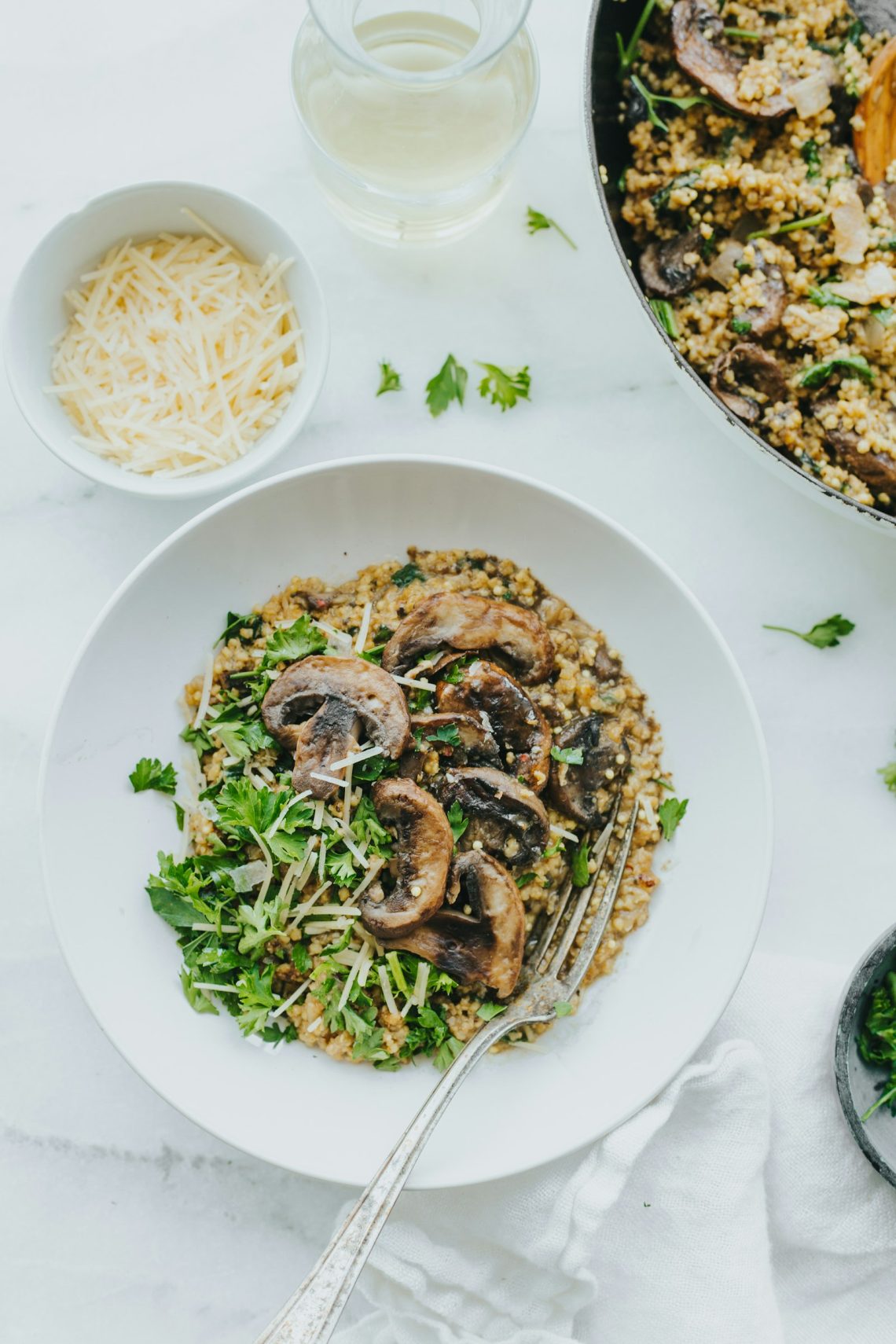
Pearl barley brings a different kind of comfort to risotto: the grains stay pleasantly chewy while the surrounding liquid becomes creamy. This pearl barley risotto without wine starts with well-browned mushrooms, uses warm vegetable broth for its body, and finishes with a little lemon to keep the flavor from feeling heavy.
It is not a rice risotto with a simple grain swap. Barley takes longer to soften and can accept more liquid at the beginning, so the method is designed around those differences. You will stir periodically rather than constantly, then pay closer attention near the end. The result is a bowl of mushrooms and grains that feels substantial enough for dinner with a green vegetable alongside.
Pearl barley risotto without wine: the right grain
Buy pearl barley for the timing given here. Its outer layers have been polished, allowing it to cook more quickly than hulled barley. Hulled barley retains more of the outer grain and generally needs more time and liquid. Quick-cooking barley is also different; it can become soft before the mushrooms and broth have had time to develop a cohesive texture.
Rinse the pearl barley briefly and drain it well. A little surface starch remains available to thicken the pot, but the recipe does not depend on the exact starch behavior of Arborio rice. Barley contains gluten, so this dish is not suitable for a gluten-free diet. If a gluten-free grain is required, choose a recipe developed for that grain rather than expecting the same liquid ratio and cooking time to transfer unchanged.
Brown the mushrooms before building the pot
Mushrooms release water before they develop deep color. Use a wide pan, moderate-to-high heat, and enough time for that liquid to evaporate. Stir occasionally, then leave the slices in contact with the pan so their edges can brown. If you crowd a small saucepan, the mushrooms will steam and the final flavor will be milder.
Reserve half the browned mushrooms for topping. The mushrooms left in the pan flavor the barley, while the reserved pieces retain more distinct texture. This small division makes the finished dish more interesting without requiring a separate garnish. Cremini mushrooms are a useful baseline. A mixture of cremini and shiitake can add depth, but remove tough shiitake stems and keep the total mushroom weight the same.
Use broth in two stages
The first three cups of broth let the barley begin softening without demanding constant attention. Keep the pan at a gentle simmer and the lid partly open. Stir every few minutes, especially along the bottom, because grains can settle and stick even when the top still looks liquid.
After the first half hour, uncover the pan and add the remaining broth in smaller portions. At this stage, the grains and liquid should begin moving together. Taste a grain rather than judging only by the clock. It should be tender enough to chew comfortably, with some resilience rather than a hard center. If the barley is still firm, add hot water or broth and continue. Turning the heat very high only evaporates liquid faster; it does not reliably soften the center of the grain.
Finish for creaminess, not a stiff mound
Remove the pan from the heat before adding cheese and optional butter. Stirring them into a boiling pot can make the finish less smooth and reduce the broth too far. The risotto should spread gently in a shallow bowl. If it stands in a compact heap, loosen it with a little more hot liquid.
Choose a hard cheese labeled as made with vegetarian rennet when keeping the meal vegetarian; traditional Parmesan is not automatically suitable. The cheese adds salt, so taste after it melts before adjusting seasoning. Lemon juice stands in for the bright finish some cooks seek from wine, but it is added near the end rather than used as a one-for-one replacement. Start with the measured two teaspoons, then add a little more only if the dish tastes flat.
Serving, scaling, and saving a portion
Serve the barley promptly in warm bowls and place the reserved mushrooms on top. Parsley supplies a fresh contrast to the earthy mushrooms and thyme. A simple roasted broccoli or asparagus side keeps the meal balanced in texture. Bread is optional because the grain already makes the bowl substantial.
For a larger batch, use a wider pot and expect the exact broth requirement to change with evaporation. Do not double the salt blindly if your broth is already well seasoned. Leftover barley thickens considerably in the refrigerator. Reheat it with a few tablespoons of water or broth per portion, stirring until it relaxes. A spoonful of fresh parsley after reheating helps restore the contrast that is strongest on the first day.
Cooling and storage
Divide the risotto into shallow containers instead of cooling it as one deep mass. Refrigerate leftovers in shallow containers within two hours, or one hour when the surrounding temperature is above 90°F. Keep the refrigerator at 40°F or colder and use cooked leftovers within three to four days. These limits follow USDA leftover guidance. Reheat cooked leftovers to 165°F, as advised by FoodSafety.gov. Freeze portions for up to two months for best quality; the barley will be softer after thawing.
Know when to stop
A successful pearl barley risotto without wine has tender grains, a loose creamy base, and mushrooms that still taste distinct. Stop cooking when the barley reaches that point, even if a little broth remains in the warming saucepan. The grain will continue absorbing liquid as you carry the bowls to the table.
Frequently asked questions
Can I make this with hulled barley?
You can, but it becomes a different timing exercise. Expect a longer simmer and additional liquid, and follow the grain package as a starting point. The finished texture will be firmer and less creamy than the pearl barley version described here.
Do I need to stir constantly?
No. Stir periodically during the first part of cooking and more often as the liquid thickens. Constant vigorous stirring is unnecessary, but leaving the pot unattended for a long stretch can allow grains to catch on the bottom.
Can I leave out the cheese?
Yes. Omit it and the optional butter for a dairy-free version, then taste for salt and lemon. A small drizzle of olive oil at the end can add richness. The barley itself still gives the cooking liquid body.
Why is my barley tender but the pot watery?
The pan may have lost less liquid than expected. Simmer uncovered for a few more minutes, stirring, until the liquid becomes creamy. Do not keep cooking until dry; the barley will absorb more liquid while resting and during storage.
More useful recipes and cooking guides
- For a brothier barley meal, try Small-Batch Mushroom Barley Soup Without Wine.
- Pair the risotto with How to Roast Broccoli So It Gets Brown and Crisp.
Mushroom Pearl Barley Risotto Without Wine
Ingredients
Equipment
Method
- Warm the broth in a small saucepan. Heat 1 tablespoon olive oil in a wide heavy saucepan over medium-high heat. Add mushrooms and cook for 7–9 minutes, stirring occasionally, until released moisture evaporates and the edges brown. Transfer half the mushrooms to a bowl for topping.
- Lower the heat to medium. Add remaining oil and onion to the pan. Cook for 5 minutes until softened. Add garlic and thyme and stir for 30 seconds. Add drained barley and stir for 1 minute.
- Pour in 3 cups hot broth and add salt and pepper. Bring to a simmer, then cook partly covered for 30 minutes, stirring every few minutes and scraping the base.
- Uncover and add the remaining broth in 1/2-cup portions as needed. Cook for another 10–15 minutes, stirring more often, until the barley is tender with a pleasant chew and the liquid is creamy. Add extra hot broth or water if it thickens before the grains are tender.
- Remove from heat. Stir in cheese, optional butter, and lemon juice. Rest for 2 minutes, loosen with a little hot broth if necessary, and top with reserved mushrooms and parsley. Taste before adding more salt.




