
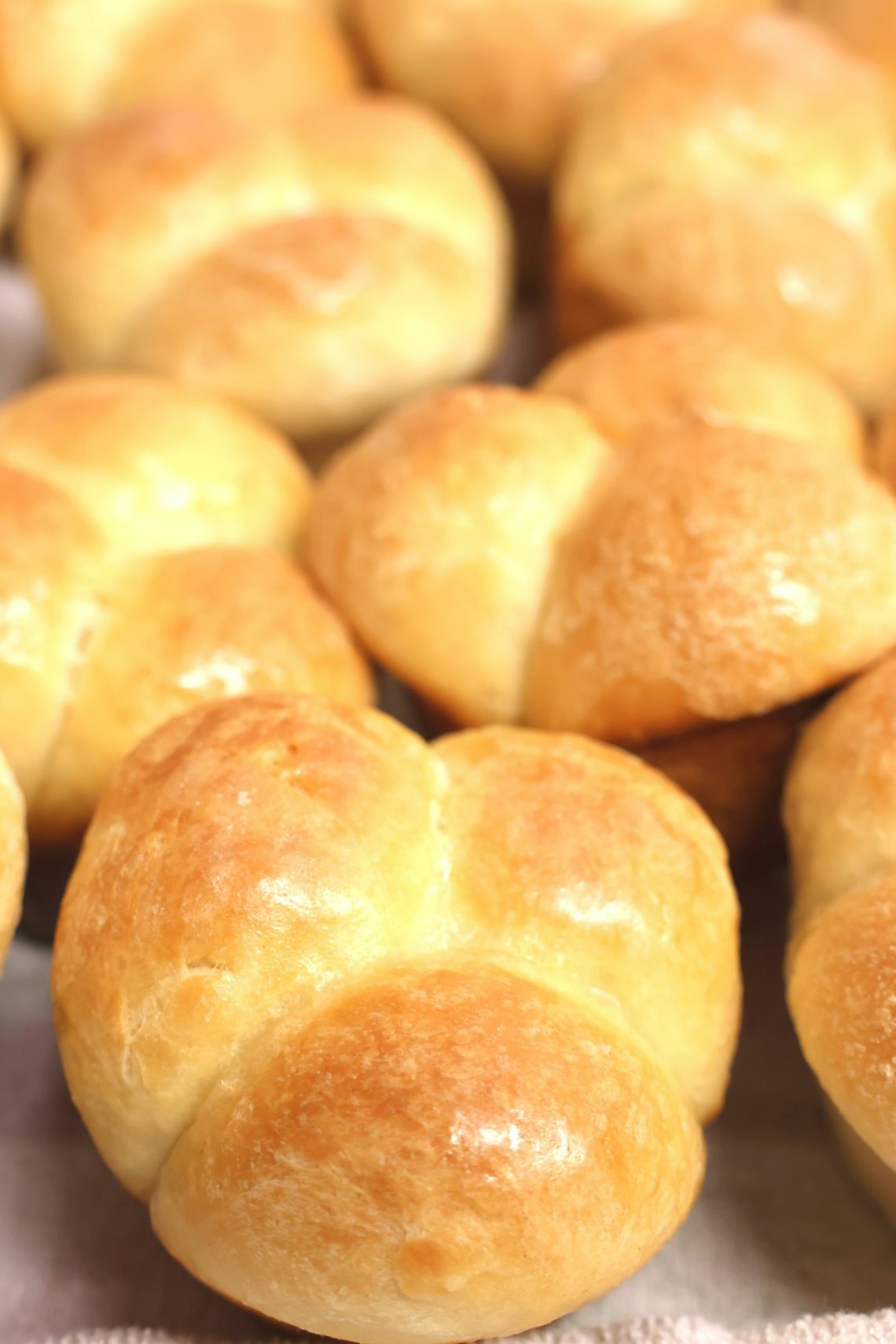
Small batch tangzhong milk bread rolls use a small cooked flour-and-milk paste to make eight soft, pull-apart rolls. The method looks like an extra step, but it takes only a few minutes in a saucepan. Once the paste cools, it becomes part of an enriched dough with milk, egg, and butter.
These rolls are gently sweet and work for breakfast sandwiches, a little jam, or a basket beside soup. They are baked close together in an 8-inch square pan so their sides remain soft. Allow time for two rises and a short cooling period; rushing either proof can leave the centers tight instead of fluffy.
What tangzhong changes
Tangzhong is a cooked mixture of a small portion of the recipe’s flour and liquid. Heating it thickens the starch before it enters the dough. This lets the finished bread retain moisture while still being manageable to shape. King Arthur Baking tangzhong technique guide describes a common starting ratio of one part flour to five parts liquid by weight; this recipe uses 20 grams flour and 100 grams milk.
Keep those amounts within the recipe totals. The flour and milk in the saucepan are not additions on top of the main dough quantities. A common mistake is to make a paste and then add the full flour and liquid amounts again, creating a much wetter dough than intended. The ingredient list separates the paste from the remaining dough ingredients for clarity.
Cook the paste without scorching it
Whisk the 20 grams of flour and 100 milliliters of milk in a small saucepan while cold. Cook over medium-low heat, stirring constantly, until it becomes a thick paste and the whisk leaves visible trails. It should thicken smoothly rather than boil vigorously or develop browned spots.
Scrape the paste into the mixing bowl and let it cool until lukewarm. Spreading it over the bottom of the bowl helps it cool faster. Do not add yeast or egg to a steaming-hot paste. If a thin skin forms, whisk it back in while the mixture is still warm. The paste should be soft enough to mix evenly with the remaining milk.
Knead before adding all the butter
Combine the cooled paste with the remaining milk, egg, sugar, flour, yeast, and salt. The dough will be sticky at first. Knead until it begins to gather and stretch, then add the softened butter in two or three portions. Each addition makes the dough briefly slippery; keep mixing until it is absorbed before adding more.
A stand mixer makes this easier, but hand kneading works with patience and a dough scraper. The finished dough should be supple and elastic, with a smooth surface. Avoid adding repeated handfuls of flour just because the dough clings to your fingers. A little tackiness is appropriate for soft milk bread; a stiff dough will bake into firmer rolls.
Use the rise to judge readiness
Cover the dough in a lightly greased bowl and let it nearly double, typically 60–90 minutes. Enriched dough can rise more slowly than a lean flour-and-water dough because it contains sugar and fat. Choose a warm room-temperature spot rather than a hot surface.
Divide the dough into eight equal pieces, about 80 grams each, and shape them into smooth balls. Pull the outer edges underneath and pinch the base closed to create a taut top. Arrange the balls in two rows of four in a greased 8-inch square pan. Leave small gaps at first; the rolls should swell until they nearly touch during the final proof.
Bake for soft sides and a golden top
Brush the tops lightly with milk once the rolls look puffy. Too much milk can pool between the rolls, so use a soft brush and a thin layer. Bake at 350°F until evenly golden and the middle rolls reach about 190°F. Check the center of a roll rather than pushing the thermometer into the gap between them.
If the top colors early, tent loosely with foil. Let the rolls sit in the pan for 10 minutes, then move them to a rack. Pulling them apart straight from the oven can compress their delicate centers. A short cooling period keeps them warm enough to enjoy while allowing the crumb to settle.
Keeping the rolls soft and using leftovers
Once cool, store the rolls in an airtight container for up to two days for best quality. For longer storage, wrap and freeze them individually or as a small group. Thaw covered so their surfaces do not dry out, then warm briefly in the oven. Avoid repeatedly reheating the whole batch when you only need one roll.
These are soft dinner-roll-sized breads, so use a modest amount of filling for sandwiches. A thick, heavy burger can overwhelm them, while a small egg portion or a slice of cheese fits well. If you want breakfast rolls the next morning, refrigerate the shaped pan overnight, covered, and allow enough time for the rolls to become puffy before baking. The morning proof will be slower because the dough starts cold.
Frequently asked questions
Can I use all-purpose flour?
Bread flour gives the most structure for this soft dough. All-purpose flour can work, but it may need gentler handling and can produce a slightly lower rise. Keep the formula unchanged initially and judge after kneading before adding more flour.
Does tangzhong replace yeast?
No. The cooked paste changes moisture retention and texture; yeast still produces the gas that makes the rolls rise. Omitting yeast would give a dense baked dough rather than fluffy rolls.
Can I make four larger rolls?
You can divide into four, but the centers will take longer to cook and the pan arrangement changes. For a first batch, use eight pieces as written. Larger rolls should be baked until the middle is fully done, not removed at the original time automatically.
Why are the rolls dense despite rising?
They may have needed more kneading, a fuller final proof, or more baking. Excess flour also makes them heavy. Look for a smooth elastic dough and visibly puffy rolls before baking, then check a central roll rather than relying only on top color.
More recipes for your table
Fill a split roll with a portion from Make-Ahead Sheet Pan Egg Sandwiches with Spinach and Cheddar If your butter is still cold, use the methods in How to Soften Butter Quickly Without Melting It
Small batch tangzhong milk bread rolls are a useful way to learn the cooked-paste method without making a large batch. Keep the dough soft, let both rises finish, and give the rolls a little cooling time before pulling them apart.
Small Batch Tangzhong Milk Bread Rolls
Ingredients
Equipment
Method
- Whisk 20 g flour and 100 ml milk in a small saucepan. Cook over medium-low heat, stirring, for 1–3 minutes until a thick paste forms. Transfer to a bowl and cool until lukewarm.
- Add the remaining 120 ml milk, egg, sugar, 280 g flour, yeast, and salt. Mix and knead until the dough begins to become elastic, about 5 minutes.
- Add softened butter in small portions, kneading after each. Continue kneading 5–8 minutes until smooth, elastic, and slightly tacky. Cover and let rise 60–90 minutes until nearly doubled.
- Grease an 8-inch square pan. Divide the dough into eight equal pieces, shape smooth balls, and arrange in two rows of four. Cover and proof 40–60 minutes until puffy and nearly touching.
- Heat oven to 350°F. Brush rolls lightly with the tablespoon of milk. Bake 22–27 minutes until golden and the center of a middle roll registers about 190°F. Tent with foil if needed.
- Rest in the pan 10 minutes, then transfer to a rack. Serve warm or cool completely before wrapping.




