Family Recipe HQ • Kitchen guide
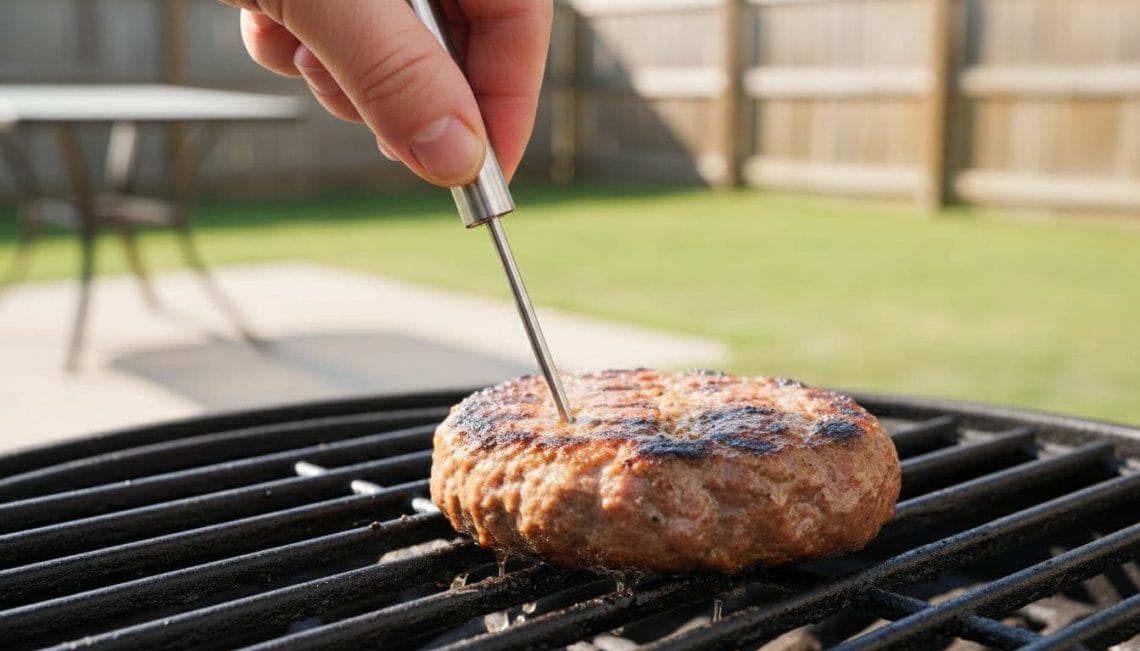
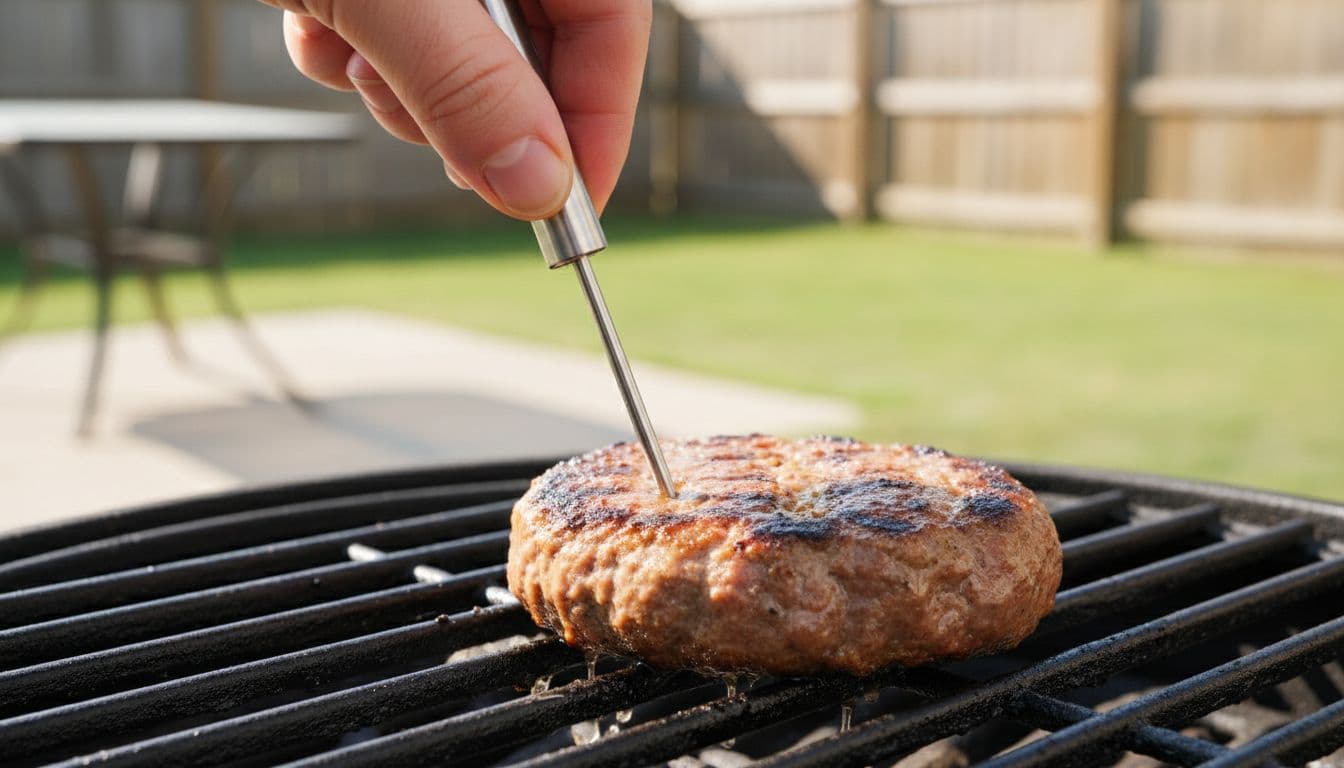
When are turkey burgers done? When the center of each patty reaches 165°F (74°C). Insert the probe through the side so the sensing tip reaches the thickest middle section, away from the cooking surface. Browning and pinkness are not reliable safety tests.
Check through the side of the patty
- Steady the patty with clean tongs or a spatula, away from the hot cooking surface.
- Insert the probe horizontally into the center, following the thermometer instructions for sensing depth.
- Wait for the reading to settle. If it seems unusually high, reposition in the thickest center.
- Continue cooking below 165°F. Check each burger rather than assuming one reading covers the whole batch.
- Transfer finished patties to a clean plate and rest about 3–5 minutes for easier handling.
This endpoint follows the FoodSafety.gov chart for ground poultry. A rest does not replace reaching 165°F before removal from the heat.
Cooking times by grill, skillet, oven, and air fryer
Time helps, but it should never be the final call. Thickness, heat, and even starting temperature change the clock. A 1/2-inch patty cooks much faster than a thick 3/4-inch burger, and high heat can brown the outside before the middle catches up.
Here’s a simple timing guide for fresh turkey burgers about 1/2 to 3/4 inch thick.
| Method | Heat | Typical time | Best note |
|---|---|---|---|
| Grill | Medium, about 400°F | 10 to 12 minutes | Flip once or twice |
| Skillet | Medium | 9 to 11 minutes, 5 minutes per side for 1/2-inch patties | Add a little oil |
| Oven | 400°F | 15 to 18 minutes | Use a sheet pan |
| Air fryer | 375°F | 10 to 12 minutes | Flip halfway |
Those times get you close. The thermometer finishes the job. Aim to cook your turkey burger patties until they are golden brown on the outside while maintaining the target internal temperature.
Medium heat helps the center catch up before the surface scorches. If a skillet burger develops a dark crust while its center is below 165°F, lower the heat and continue cooking. On the grill, move it to a cooler zone. Recheck the center rather than extending cooking by a fixed number of minutes.
Thickness matters too. Thin burgers cook fast, but they dry out fast. Thick burgers stay juicier, yet they need a little more time and steadier heat. For most home cooks, 1/2 to 3/4 inch is the sweet spot.
If you’re cooking a batch for the family, don’t assume every patty finishes together. Check the thickest one first, then spot-check another. Small size differences add up.
When two thermometer readings disagree
A number is useful only when the thermometer is measuring the right part of the burger. The surface and thin edges can be hotter than the center. Follow the thermometer’s instructions for insertion depth and allow the reading to settle with its sensing area inside the thickest middle section.
| Example reading | What it means for cooking |
|---|---|
| 170°F near the edge, 159°F in the center | The center is not ready. Continue cooking with controlled heat. |
| 164°F in the center before resting | Keep cooking. Do not assume the rest will supply the missing degree. |
| At least 165°F in the properly checked center of each patty | Transfer finished patties to a clean plate. |
These are illustrative examples, not readings from a tested batch. The cooking endpoint follows the FoodSafety.gov temperature chart for poultry, including ground turkey.
Reposition instead of averaging
If the first reading seems surprisingly high, make sure the probe has not passed through the burger or touched hot cooking equipment. Recheck the center from a suitable angle. Do not average a hot edge and a cooler center; an average does not establish that the under-temperature area has finished cooking.
Check every burger, especially when patties differ in thickness. Keep the finished ones separate from those still cooking, and use clean utensils for the final transfer. This avoids sacrificing the smaller patties to a long extra cooking interval chosen for the largest one.
Keep turkey burgers juicy
Shape the patties to an even thickness and mix only until the ingredients hold together. Very lean ground turkey dries more readily, so follow a measured burger recipe rather than adding several binders or liquids at once. Avoid pressing the patties with a spatula while they cook.
Use moderate heat once the surface has browned. Lower a skillet burner or move a grilled patty to a cooler zone if its center is still below 165°F. Remove finished patties individually so smaller burgers do not wait on the grill for larger ones.
Store and reheat safely
Refrigerate cooked food in shallow containers within 2 hours, or within 1 hour when the surroundings exceed 90°F. Keep the refrigerator at 40°F or below. Use refrigerated cooked poultry within 3–4 days and reheat leftovers to 165°F. Freeze portions you will not use in that window. See the FoodSafety.gov storage chart and safe-temperature chart.