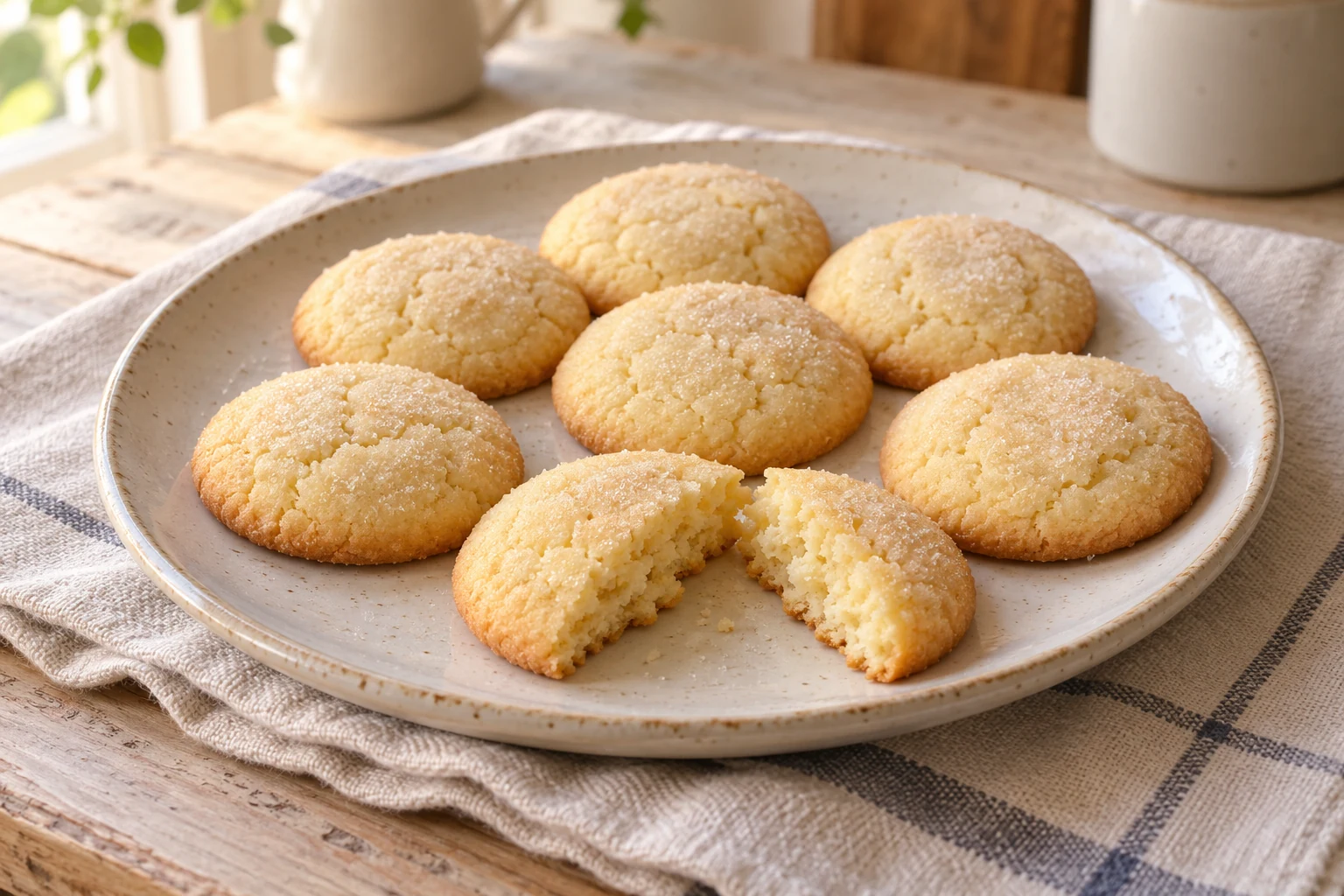
A spare egg yolk is a good reason to turn on the oven. These small batch egg yolk sugar cookies with oil bring together vanilla, ordinary pantry ingredients, and a manageable eight-cookie yield. There is no butter to soften and no mixer to wash. The dough is stirred by hand, rested briefly, and pressed into small rounds before baking.
This guide puts the measurements first, then walks through the decisions that matter: choosing an oil, recognizing workable dough, shaping even portions, and knowing when to stop baking. Expect a simple vanilla cookie with lightly colored edges; the exact texture depends on your measurements, cookie thickness, and oven.
Measure carefully
In a small batch, an extra spoonful matters. Weigh the flour and measure the oil before either reaches the mixing bowl.
Mix by hand
A fork, small whisk, and spatula are enough. Look for an evenly combined mixture, then stop folding when the flour disappears.
Shape before baking
Press matching disks instead of leaving tall balls. Similar thickness helps all eight cookies finish baking at approximately the same time.
KEEP THIS CARD BESIDE YOUR BOWL
Small batch egg yolk sugar cookies with oil
A modest batch of vanilla sugar cookies made with one large egg yolk and two tablespoons of neutral oil.
8small cookies
15 minprep, including dough rest
10–12 minestimated baking
35–37 mintotal, including 10 minutes cooling
Ingredients
1 large egg yolk, approximately 18 g
50 g granulated sugar (¼ cup)
2 tablespoons neutral oil (30 ml), such as canola or sunflower
2 teaspoons milk (10 ml)
½ teaspoon vanilla extract
75 g all-purpose flour (½ cup plus 2 tablespoons, spooned and leveled)
¼ teaspoon baking powder
⅛ teaspoon fine salt
Optional: 1 teaspoon additional granulated sugar, divided over all eight cookies
Equipment
Use a medium bowl, fork or small whisk, flexible spatula, measuring spoons, kitchen scale or dry measuring cups, light-colored metal baking sheet, parchment paper, and cooling rack. A small flat spatula makes it easier to lift the cooled cookies without breaking their edges.
Before you start: This recipe contains egg, wheat, and milk. It is made without butter, but the original ingredient list is not dairy-free. Baking time is an estimate; use the doneness cues below as well as the clock.
Ingredient arrangement for a small baking session; use the written measurements in the recipe card.
FROM MIXING BOWL TO COOLING RACK
The six-step baking method
Prepare the oven and measure everything
Heat the oven to 350°F (175°C) with a rack in the center. Line a cool baking sheet with parchment. Measure the flour into a separate small bowl and stir in the baking powder and salt. This distributes the tiny quantities before they enter the wet mixture. Measure the oil over a separate container so an accidental spill cannot change the recipe. Have the milk and vanilla ready.
Whisk a smooth, evenly mixed base
Put the yolk, sugar, oil, milk, and vanilla in your mixing bowl. Whisk for about 45 seconds, scraping around the edges if needed. Look for a consistent, glossy mixture without a separate ring of oil. The sugar may still feel grainy; you are combining the ingredients, not trying to dissolve every crystal. A large stand mixer is awkward for this small quantity, and prolonged beating is unnecessary.
Fold in the flour, then pause
Add the flour mixture and fold with a spatula, reaching underneath the dough to catch dry pockets. Stop once no loose flour remains. Let the dough rest for 10 minutes. After resting, a pinched piece should hold together when gently pressed. Do not immediately correct a freshly mixed dough with a large splash of liquid or a handful of flour; check the texture after the pause first.
Make eight matching disks
Divide the dough into eight portions, approximately 23 g each. Gently round them and place them at least 2 inches apart. Press each portion to roughly 1¾ inches across and ⅜ inch thick. Matching thickness matters more than drawing perfect circles. Press through a small piece of parchment if the dough sticks to your fingertips. Divide the optional teaspoon of sugar over the tops.
Shape the portions into even disks and leave space around each one before baking.
Bake until the edges and surface set
Bake for an estimated 10–12 minutes, beginning your checks at 10 minutes. The edges should look set, the surface should no longer look wet, and a little golden color should appear at the rim or underneath. If the center still looks wet, continue baking and check again shortly. The whole top does not need to turn brown. Rotate the tray only if you know your oven browns unevenly.
Give the cookies time to firm
Set the baking sheet on a heatproof surface and leave the cookies there for 5 minutes. Slide a thin spatula underneath and transfer them to a rack for at least another 5 minutes. Freshly baked cookies can break when lifted too soon. Let them cool completely before packing, and judge the final texture after cooling rather than while the centers are still warm.
Serving illustration showing a fine crumb and lightly golden edges; allow your batch to cool before checking its texture.
UNDERSTAND THE INGREDIENTS
Why oil, one yolk, and careful measuring matter
Oil changes the mixing method
Oil does not trap air with sugar the way softened butter does during creaming. Serious Eats’ comparison of butter and oil demonstrates why a direct substitution can change cookie texture. Here, follow the measured oil formula and simple stirring method. Do not keep whisking in search of a fluffy butter-and-sugar mixture, or assume that extra oil will make the finished cookies softer.
A yolk is different from a whole egg
Yolks supply fat and emulsifiers. Stella Parks’ cookie experiments show that changing egg composition can change results, depending on the recipe and mixing method. Use the specified single yolk here.
The flour measurement deserves attention
Set an empty bowl on your scale, zero it, and add 75 g flour. Without a scale, loosen the flour in its container, spoon it gently into the half-cup measure, level it, then add two separately leveled tablespoons. Do not tap or pack the cup. King Arthur Baking’s flour-measuring guide explains why packed cups can contain substantially more flour than lightly filled ones. In this recipe, the gram amount is the clearest reference when cup measurements disagree.
Choose an oil that suits a plain vanilla cookie
Oil
What to consider
Canola or sunflower
A mild choice when you want vanilla to lead. Use fresh oil with no stale or unpleasant aroma.
Mild olive oil
Choose it when a little olive flavor sounds appealing; finely grated citrus zest is a possible companion.
Strong extra-virgin olive oil
Its flavor can be prominent in a small, plain cookie. Make this an intentional variation.
Coconut oil
It changes firmness with temperature. This recipe does not offer a direct coconut-oil conversion.
A QUICK LOOK BEFORE YOU CHANGE THE DOUGH
Practical fixes for common cookie problems
When making small batch egg yolk sugar cookies with oil, make one small adjustment at a time. Check the measurements and the rested dough before changing the formula; several large corrections can create a new problem.
The dough crumbles apart
First press a small piece together. A few edge cracks are different from dough that will not hold a shape. If it remains dry and loose after resting, fold in ½ teaspoon milk and check again. Avoid pouring directly from the carton: this batch needs a measured correction.
The dough is too loose to shape
Confirm that you added the full 75 g flour and only two tablespoons of oil. After the rest, add flour by the teaspoon only if needed. A short refrigerator pause can help with handling in a warm kitchen, but chilling cannot repair a substantial measuring error.
The cookies spread into greasy puddles
Possible causes include excess oil, too little flour, or starting on a hot sheet. Use a cool pan and parchment for each batch. If making a second tray, let the first pan cool before placing more dough on it. Review your oil measurement before automatically adding more flour.
The bottoms brown before the centers set
Check that the tray sits on the center rack. Dark pans may brown the underside sooner, so inspect early. Use a light-colored sheet next time and compare the oven setting with an oven thermometer if the problem repeats. Do not compensate by leaving a thick, wet center unfinished.
The cooled cookies seem dry or hard
Look at baking time, flour measurement, and thickness. Very thin portions can finish sooner than expected. On the next batch, weigh the flour, press evenly, and check promptly. Aim for a set cookie with light edge color rather than waiting for a deep brown surface everywhere.
The cookies break during transfer
Give them their full rest on the baking sheet and use a thin spatula that supports the center. Moving a fragile cookie with a fork can split it. If one breaks, leave the others a little longer before lifting; cooling is part of the process.
Optional first-cookie check: If your oven or pan is unfamiliar, bake one portion first and refrigerate the remaining dough while you assess it. Use a cooled pan for the rest. This adds time to the recipe, but lets you adjust thickness or baking time before committing all eight portions.
Small flavor changes, plus a sixteen-cookie batch
Begin with the plain vanilla version so you have a useful reference. For another batch, try ¼ teaspoon finely grated lemon or orange zest, or ⅛ teaspoon cinnamon mixed into the flour. Keep the zest fine and avoid the bitter white pith. These are modest variation ideas; they have not been verified as identical in texture to the base recipe.
For a little chocolate, use no more than a tablespoon of finely chopped chocolate across the batch. Large chunks make small disks harder to shape evenly. Do not substitute cocoa powder for part of the flour without using a recipe designed for cocoa. A generous drizzle or frosting also changes how the cookies should be packed and stored.
To double the recipe
Use 2 yolks, 100 g sugar, 4 tablespoons (60 ml) oil, 4 teaspoons (20 ml) milk, 1 teaspoon vanilla, 150 g flour, ½ teaspoon baking powder, and ¼ teaspoon fine salt. Use up to 2 teaspoons extra sugar for topping. Divide into sixteen approximately 23 g portions and keep the original thickness.
Do not double the baking time. Bake one tray at a time if sixteen cookies cannot fit with adequate spacing, refrigerating the waiting portions. Start checking each tray at the original time and allow the pan to cool between rounds. This method increases the total session time, even though each cookie is the same size.
Store the cookies and handle the spare egg safely
For the best texture, keep fully cooled, plain cookies in an airtight container at room temperature and enjoy within three days. Separate stacked layers with parchment. For longer storage, freeze the cooled cookies in a sealed container for up to one month for best quality. Thaw the amount you want; the rims may be less crisp after storage.
For a make-ahead batch, cover the portioned dough and refrigerate until the following day, provided its ingredients are still within their storage windows. FoodSafety.gov lists raw yolks and whites for 2–4 days at 40°F (4°C) or below. Label the leftover yolk or white with the separation date; mixing a yolk into dough does not start a new storage period.
Skip the raw-dough taste: Flour and raw eggs can carry harmful bacteria. Follow FDA’s guidance on handling flour safely: bake the dough before eating, keep it away from ready-to-eat food, and wash hands, utensils, and work surfaces after mixing.
THE QUESTIONS THAT COME UP AT THE COUNTER
Small batch egg yolk sugar cookies with oil: reader questions
Can I use a whole egg instead of one yolk?
Keep the yolk-only measurement for this formula. A whole egg adds considerably more liquid and egg white. Doubling the batch calls for two yolks, not one whole egg. Save the white separately in a covered, refrigerated container for another cooked recipe.
Does this dough need an overnight chill?
The base method uses a ten-minute rest, not an overnight chill. Overnight refrigeration is a make-ahead option. If refrigerated portions are too firm to flatten, let them stand only until workable, then shape to the stated thickness and bake.
Can I make the cookies without dairy milk?
You can try the same two teaspoons of an unsweetened plant beverage or water. Do not simply omit the liquid. Flavor and texture may differ slightly, and anyone avoiding dairy for allergy reasons should check every ingredient label and prevent cross-contact.
Can I use self-rising flour?
All-purpose flour with separately measured baking powder and salt is the preferred starting point. Self-rising flour already contains raising agents and salt, with proportions that may differ by brand. It is not a direct substitution in this small formula.
Can I reduce the sugar?
Sugar affects the dough and finished texture as well as sweetness. This guide does not provide a tested reduced-sugar version. Make the original batch first; if you experiment later, record the change and expect the spread and texture to change too.
Will this dough work with cookie cutters?
It is written for gently pressed rounds. Rolling it thin, adding bench flour, and cutting detailed shapes changes the handling and baking requirements. Choose a dedicated roll-out sugar-cookie recipe for decorated shapes that need to retain crisp outlines.
Can I replace the flour with almond or coconut flour?
Those flours behave differently from wheat flour and are not one-for-one replacements here. Use a recipe developed for your chosen flour. A gluten-free flour blend would also require a separate trial before promising the same result.
2tablespoonsneutral oil30 ml; canola or sunflower oil
2teaspoonsmilk10 ml
1/2teaspoonvanilla extract
75gall-purpose flour½ cup plus 2 tablespoons, spooned and leveled
1/4teaspoonbaking powder
1/8teaspoonfine salt
1teaspoonadditional granulated sugaroptional; for topping all eight cookies
Instructions
Prepare Heat the oven to 350°F (175°C) with a rack in the center. Line a cool baking sheet with parchment. In a small bowl, stir together the flour, baking powder, and salt.
Mix the wet ingredients In a medium bowl, whisk the egg yolk, sugar, oil, milk, and vanilla for about 45 seconds, until evenly combined and glossy with no separate ring of oil. The sugar may remain slightly grainy.
Add the dry ingredients and rest Fold in the flour mixture with a spatula until no dry flour remains. Let the dough rest for 10 minutes. A small piece should hold together when gently pressed.
Shape Divide into eight portions, approximately 23 g each. Round gently and arrange at least 2 inches apart. Flatten each portion to about 1¾ inches across and ⅜ inch thick. Divide the optional teaspoon of sugar over the tops.
Bake Bake for approximately 10–12 minutes, checking at 10 minutes. Look for set edges, a surface that no longer looks wet, and light golden color around the rim or underneath. If the center still looks wet, continue baking and check again shortly.
Cool Leave the cookies on the baking sheet for 5 minutes. Transfer carefully to a rack with a thin spatula and cool for at least another 5 minutes. Cool completely before storing.
Notes
Timing: Prep includes the 10-minute dough rest. Total time includes 10 minutes cooling and is approximately 35–37 minutes. Allow extra time for complete cooling before storage, an optional trial cookie, or additional trays.Measurements and texture: Weigh the flour when possible. Use the yolk only and the measured two tablespoons of oil. After resting, if the dough will not hold together, add milk ½ teaspoon at a time. If it is too loose, check the measurements before adding flour 1 teaspoon at a time.Storage: Store fully cooled, plain cookies airtight at room temperature for up to three days for best texture, or freeze for up to one month for best quality. Separate stacked layers with parchment.Make ahead: Cover and refrigerate the portioned dough until the next day, within the yolk’s original storage window. Raw separated yolks and whites should be refrigerated at 40°F (4°C) or below and used within 2–4 days of separation.Food safety and allergens: Do not taste raw dough. Wash hands, utensils, and work surfaces after handling raw flour and egg. This recipe contains egg, wheat, and milk; made without butter does not mean dairy-free.
Rate This Recipe
Made these cookies? Choose a star rating in the comment form and tell us how your batch turned out. Your pan, baking time, and any changes you tried can help the next reader.
Family Recipe HQ is the site’s editorial publishing account. It publishes practical recipes, cooking methods, doneness guides, storage guidance, and resources for preserving family food traditions. Articles do not claim kitchen testing unless a documented test record supports that statement. Corrections and image-rights concerns can be submitted through the Contact Us page.
Essential cookies enable basic functions and are necessary for the proper function of the website.
Name
Description
Duration
Cookie Preferences
This cookie is used to store the user's cookie consent preferences.
30 days
These cookies are needed for adding comments on this website.
Name
Description
Duration
comment_author
Used to track the user across multiple sessions.
Session
comment_author_email
Used to track the user across multiple sessions.
Session
comment_author_url
Used to track the user across multiple sessions.
Session
Google's current Sign in with Google client library. It renders the Google sign-in button, or the One Tap prompt, so visitors can log in to your site with their Google account. It replaces the older Google Sign-In platform library.
Set on your own domain by the Sign in with Google client library. Records whether the visitor has dismissed the One Tap sign-in prompt and for how long it should stay hidden, plus the time the library last loaded and a browsing session id used for the same purpose. Sites that pass a custom state_cookie_name will see that name instead.
180 days
g_csrf_token
Set on your own domain by the Sign in with Google client library and submitted together with the sign-in credential, so your site can confirm the sign-in came from its own page and not from a forged cross-site request.
5 minutes
Google Tag Manager simplifies the management of marketing tags on your website without code changes.
Contains information related to marketing campaigns of the user. These are shared with Google AdWords / Google Ads when the Google Ads and Google Analytics accounts are linked together.
90 days
__utma
ID used to identify users and sessions
2 years after last activity
__utmt
Used to monitor number of Google Analytics server requests
10 minutes
__utmb
Used to distinguish new sessions and visits. This cookie is set when the GA.js javascript library is loaded and there is no existing __utmb cookie. The cookie is updated every time data is sent to the Google Analytics server.
30 minutes after last activity
__utmc
Used only with old Urchin versions of Google Analytics and not with GA.js. Was used to distinguish between new sessions and visits at the end of a session.
End of session (browser)
__utmz
Contains information about the traffic source or campaign that directed user to the website. The cookie is set when the GA.js javascript is loaded and updated when data is sent to the Google Anaytics server
6 months after last activity
__utmv
Contains custom information set by the web developer via the _setCustomVar method in Google Analytics. This cookie is updated every time new data is sent to the Google Analytics server.
2 years after last activity
__utmx
Used to determine whether a user is included in an A / B or Multivariate test.
18 months
_ga
ID used to identify users
2 years
_gali
Used by Google Analytics to determine which links on a page are being clicked
30 seconds
_ga_
ID used to identify users
2 years
_gid
ID used to identify users for 24 hours after last activity
24 hours
_gat
Used to monitor number of Google Analytics server requests when using Google Tag Manager
1 minute
Marketing cookies are used to follow visitors to websites. The intention is to show ads that are relevant and engaging to the individual user.
AddToAny provides share and follow buttons that let visitors post your pages to social networks, messaging apps, and bookmarking services.