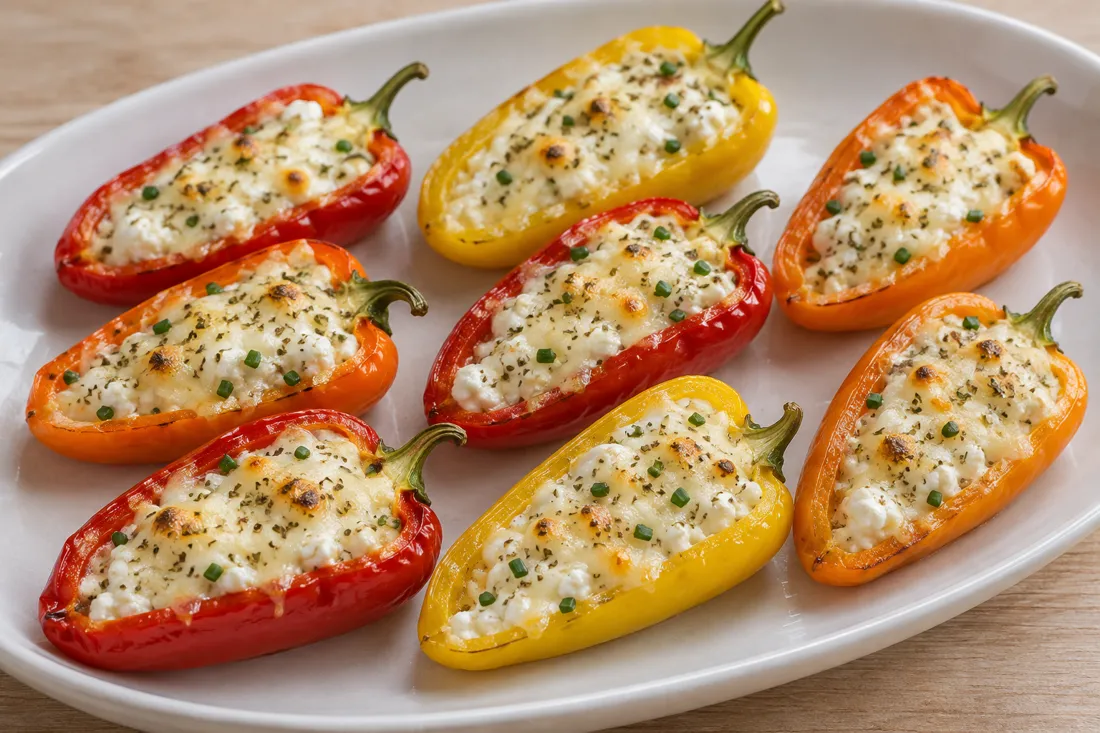
Mini sweet peppers make convenient little boats for a warm cheese filling. These air fryer stuffed mini peppers with cottage cheese combine drained cottage cheese, mozzarella, Parmesan, and herbs. The cottage cheese keeps the filling mild, while the smaller amount of melting cheese helps it settle into the pepper halves instead of behaving like a loose spoonful of curds.
Jump to recipe · Rate this recipe
Affiliate disclosure: As an Amazon Associate I earn from qualifying purchases. These paid links open Amazon search results so you can compare suitable tools.
The draining step is easier to manage with a fine-mesh strainer (paid link). A pair of silicone-tipped kitchen tongs (paid link) helps lift the filled pepper halves from the basket; follow your air-fryer basket care instructions.
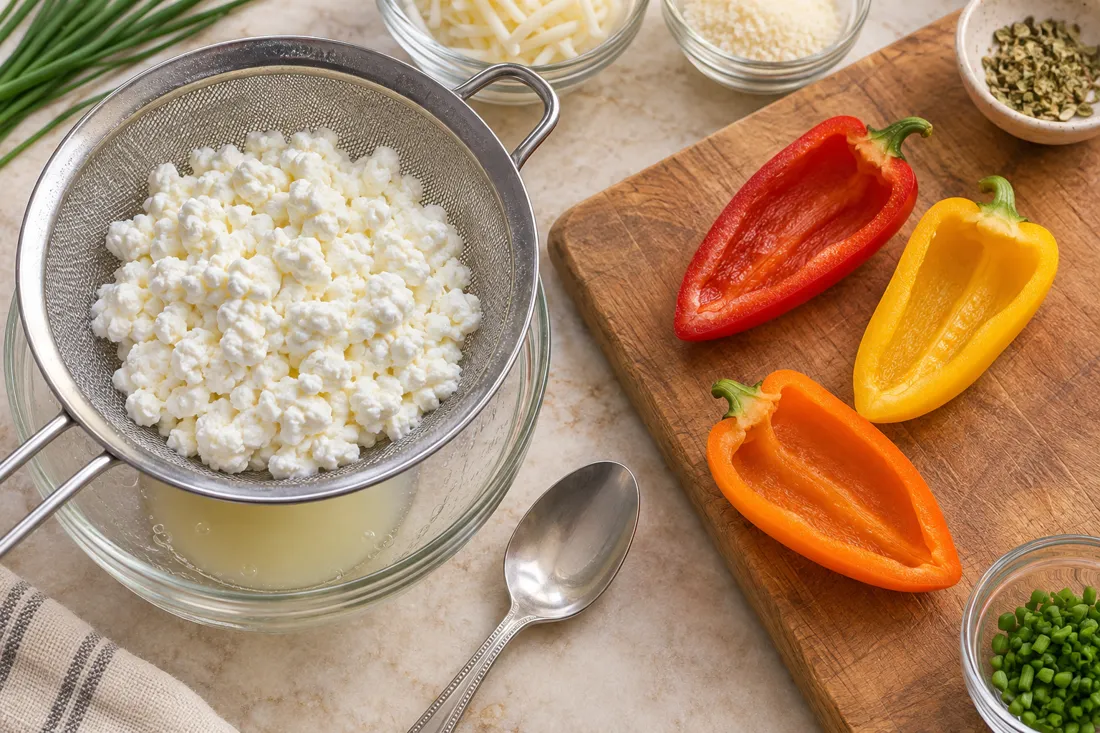
The practical detail is draining. Cottage cheese varies from fairly dry curds to a loose mixture with visible liquid, and that difference affects what happens in the basket. Drain until the measured filling is thick enough to mound on a spoon, then fill the peppers modestly rather than piling cheese far above their rims.
Keep the pepper shells firm and the filling creamy
Dry the peppers
Moisture inside the halves thins the cottage-cheese filling and encourages steaming instead of light browning.
Fill below the rim
A modest mound stays in place as the cheese warms; overfilled peppers can spill into the basket and scorch.
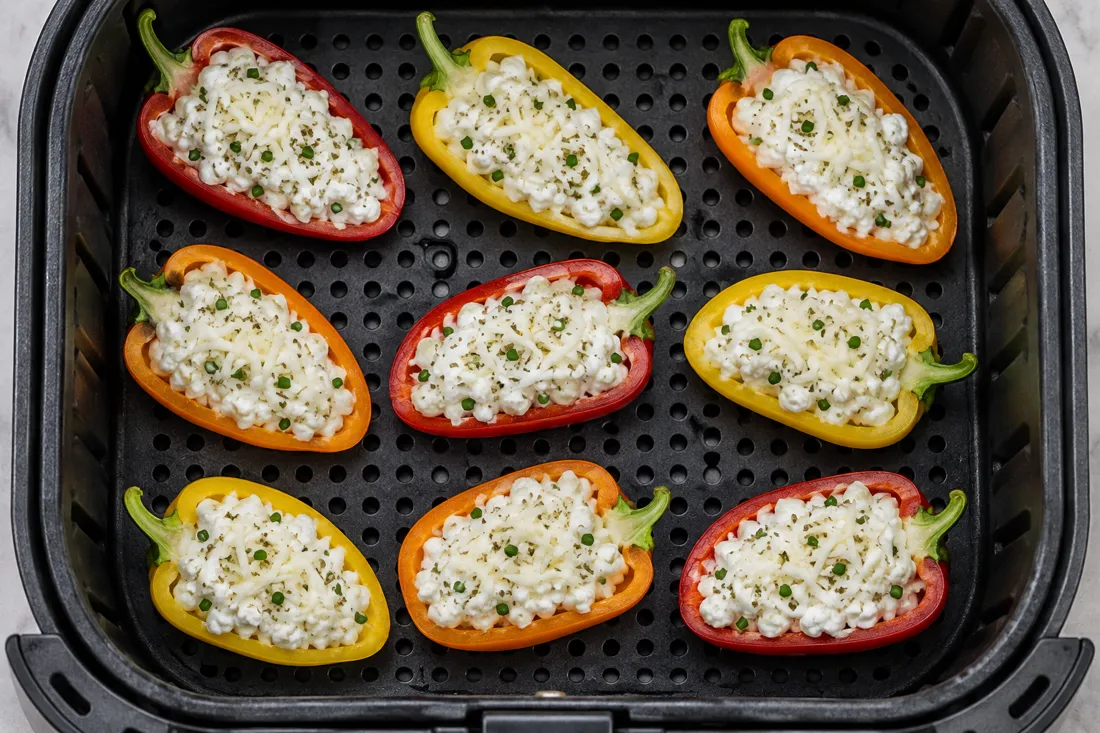
Arrange the halves in one layer and check the thickest pepper wall for tenderness. If the filling is hot before the shell softens, lower the air-fryer temperature slightly and continue briefly rather than darkening the cheese.
What this batch makes
Yield: approximately 20 pepper halves, 4 appetizer or snack servings. Prep: 15 minutes, including a short drain. Cook: 16–24 minutes for two batches. Stand: 3 minutes. Total: about 42 minutes. Use a 5–6-quart basket air fryer, a fine-mesh strainer, a small bowl, a teaspoon, tongs, and a food thermometer.
The number of batches depends on pepper size and basket surface. The peppers should rest flat in one layer, open side up. They do not need wide gaps like breaded food, but do not stack them or let one rest on another’s filling. Make the first batch a little smaller if you are learning how your model heats.
Choose a resting side before filling
Turn each empty pepper half over in your hand and look for the broadest outer surface. A curved half may sit more securely with its stem pointing toward the basket wall, while a flatter half can occupy the center. Try the arrangement in the cool, empty basket before any cheese is added. This makes it easier to see which pieces need a neighboring pepper for support.
Do not trim a hole through the bottom to make a pepper sit flat. That removes the surface that needs to hold the filling. Instead, use the natural curves and leave small gaps for air. A pepper that will only balance when tightly wedged into a crowded basket belongs in the next batch.
Ingredients
- 10 ounces mini sweet peppers, approximately 10 small peppers
- ½ cup drained cottage cheese, measured after draining
- ⅓ cup shredded low-moisture mozzarella, about 40 grams
- 1 tablespoon finely grated Parmesan
- 1 tablespoon finely chopped chives or scallion greens
- ¼ teaspoon garlic powder
- ¼ teaspoon dried oregano
- ⅛ teaspoon black pepper
- 1 teaspoon olive oil, divided between peppers and basket if needed
- 1 teaspoon lemon juice, optional, for serving
Mini sweet peppers are mild peppers, not mini hot chiles. If the package is unfamiliar, confirm what you are buying before preparing a snack for children. Red, orange, and yellow peppers make an attractive mixed plate; use pieces with enough flat surface to sit securely in the basket.
Low-moisture mozzarella is useful because fresh mozzarella can release more water. Parmesan brings salt and flavor, so no extra salt is listed initially. Taste a little of the clean filling before it goes into the peppers and add only a tiny pinch if the cheeses are unusually mild.
Fill from the center toward the ends
Set the drained filling bowl beside a plate of prepared halves. Use one teaspoon to place a small mound in the middle and the back of another to spread it gently toward the narrow end. The spoon should move the cheese without pressing hard against the pepper wall. Small curds can remain visible; smoothing them into a perfectly flat paste is unnecessary.
Distribute a first spoonful among all twenty halves before adding the rest. This allows for peppers with different cavity sizes and helps avoid a few overfilled boats followed by several nearly empty ones. Keep the cheese close to the rim so it has room to settle as the pepper softens.
Prepare the peppers and filling
- Drain the cottage cheese. Spoon slightly more than ½ cup into a fine-mesh strainer over a bowl. Refrigerate while it drains for about 10 minutes, pressing gently with a spoon if it is especially wet. Measure ½ cup after draining. Do not squeeze it so aggressively that the curds become completely dry.
- Prepare the peppers. Wash and dry them, then slice lengthwise through the stem or just beside it. Remove seeds and pale inner membranes with a small spoon. Leave the stems attached as handles if desired, but remember they are not meant to be eaten.
- Make the filling. Stir cottage cheese, mozzarella, Parmesan, chives, garlic powder, oregano, and pepper in a small bowl. Break up very large curds with the back of a fork. The mixture should hold on a teaspoon without liquid collecting underneath.
- Fill without overloading. Rub the outside of the pepper halves with a little of the measured oil. Add approximately 2 teaspoons filling to each half, adjusting for size. Keep the filling near the rim rather than forming a tall mound. If a pepper rocks, choose a flatter side or prop it carefully against a neighbor.
- Arrange the first batch. Set the air fryer to 350°F / 175°C, preheating if the manufacturer recommends it. Lightly oil the basket if needed. Arrange filled peppers open side up in a single layer. Do not preheat with loose parchment inside an empty basket.
- Cook and inspect. Air-fry for 6 minutes, then check. Continue in 2-minute intervals until the peppers soften, the top is lightly golden in places, and the center of the filling reaches 165°F. A batch may take approximately 8–12 minutes, depending on pepper size and appliance.
- Remove gently and repeat. Lift peppers with tongs or a small spatula, supporting the bottom so the filling stays in place. Transfer to a clean plate and cook the second batch. If holding the first batch, keep it safely hot at 140°F or above; otherwise serve it promptly while the next batch cooks.
- Cool briefly for eating. Let the finished peppers stand for 2–3 minutes so the filling is less likely to burn the mouth. Add a few drops of optional lemon juice just before serving. Keep the stems visible and provide a small plate for discarding them.
Set up the second batch while the first cooks
Keep the waiting filled peppers covered in the refrigerator until basket space is available. Put a clean serving plate and a narrow spatula beside the appliance before the timer finishes. Check the fuller peppers as well as the smaller ones, and use the thermometer endpoint in the method rather than the amount of browning on the cheese. Lift from underneath; squeezing a softened side can push the hot filling out.
How air fryer stuffed mini peppers with cottage cheese should turn out
The peppers should be tender enough to bite comfortably but still hold their boat shape. The filling will remain soft, with recognizable small curds if you used a coarse cottage cheese. It is not supposed to become a firm baked custard, because this recipe contains no egg.
A little melted cheese around the edges is normal. A large puddle in the basket suggests the cottage cheese was too wet, the peppers were overfilled, or the cooking temperature was too high. More cooking will not necessarily make a wet filling stable; it may simply darken the tops.
For the baked stuffed filling, this recipe uses the 165°F casserole guideline from FoodSafety.gov. Check the middle of a larger filled pepper with a thin probe. Color alone is an unreliable measure because different cheeses brown at different rates.
Fixes for the most common issues
| Issue | Response |
|---|---|
| Filling looks runny before cooking | Drain the cottage cheese longer before mixing; do not add liquid ingredients. |
| Peppers tip over | Choose a flatter orientation and use smaller filling mounds. |
| Cheese browns too quickly | Reduce the setting slightly and continue checking the filling temperature. |
| Peppers remain very crisp | Use smaller peppers or allow extra low-temperature cooking while protecting browned tops. |
A small air fryer may need three batches. That is preferable to stacking peppers and losing control of the filling. If your model has a particularly strong fan, keep loose shredded cheese mixed into the cottage cheese instead of scattering it loosely over the tops where it can move around.
Flavor choices and realistic substitutions
Use finely chopped parsley in place of chives for a milder herb note. A small pinch of smoked paprika gives the filling warmth without making it hot. For adults who like spice, add crushed red pepper to part of the filling or serve a hot sauce separately.
Ricotta can replace cottage cheese if it is similarly thick and drained, but the filling will be smoother and the flavor slightly different. Fresh mozzarella is not a direct equivalent to low-moisture shredded mozzarella because it can release more liquid. Cream cheese makes a denser, richer filling and belongs to a different proportioned version.
Full-size bell peppers need a different preparation and longer cooking time; do not simply fill large halves and use the mini-pepper schedule. Jalapeños change the heat level substantially and require careful seed and membrane handling. Keep this recipe centered on mild mini sweet peppers unless you intentionally develop another version.
How to serve the batch
Serve as a warm snack with cucumber slices, or as part of a lunch plate with soup and toast. For a party, put out smaller batches as they finish, with a clean serving utensil. Avoid leaving a large platter of dairy-filled peppers at room temperature throughout a long event.
For children, cut the cooled cooked halves into manageable pieces when appropriate for their age and remove the stems. Let the filling cool enough to eat comfortably. These peppers are a snack or side, rather than a complete dinner on their own.
Make ahead, store, and reheat
Drain the cottage cheese and prepare the pepper halves a day ahead, keeping them covered and refrigerated separately. Mix the filling and stuff close to cooking for the driest result. If you stuff them ahead, keep refrigerated and expect a little more liquid to collect in the peppers.
Refrigerate cooked leftovers in shallow containers within 2 hours, or within 1 hour above 90°F. Store at 40°F or below for 3–4 days following USDA leftover guidance. Reheat gently until the filling reaches 165°F. A lower air-fryer setting helps warm the center before the cheese becomes too dark.
A few warm pepper halves can round out a bowl of chicken soup, especially when you want a small savory side instead of a large sandwich.
Frequently asked questions
Do I need to blend the cottage cheese?
No. Small curds give a pleasant texture and avoid another appliance. If you prefer it smooth, blend before measuring, then drain as needed; blending a very wet product does not remove its excess water.
Can I make these in an oven?
An oven version is possible, but it will need a separate timing check because a basket air fryer moves hot air differently. Use an oven-safe tray, watch the pepper texture, and check the filling reaches 165°F rather than borrowing the air-fryer time.
Should the pepper skin be black?
No. A few browned spots are fine, but the goal is a tender pepper with lightly browned cheese. Blackened skin may taste bitter and usually means the temperature or time was too high for the batch.
Can I use fat-free cottage cheese?
It may work, but brands differ in moisture and texture. Drain and measure it as written, then watch for a watery filling. The finished flavor may be less rich than a product with some milk fat.
Can I freeze the cooked peppers?
Freezing will soften the peppers and may make the cheese release more liquid after thawing. Refrigerated leftovers are the more predictable option for this formulation. If freezing a trial portion, judge its texture before preparing a larger batch that way.
What is the most important step?
For air fryer stuffed mini peppers with cottage cheese, drain the cheese until the filling can hold a modest mound. That preparation detail makes the batch easier to fill, move, and serve.
Manage batches of air fryer stuffed mini peppers with cottage cheese
Air fryer stuffed mini peppers with cottage cheese are easiest to serve when the batch plan is decided before filling. Pepper halves vary in width, cavity size, and ability to sit flat. Sort them into workable groups rather than forcing a fixed number into the basket. Keep the waiting filled peppers refrigerated and have a clean plate ready for each cooked batch.
Sort by shape as well as color
After cutting and drying the peppers, compare their cavities. A broad shallow half needs a different spooning motion from a narrow curved one, even if both came from similarly sized peppers. Pair halves with comparable depth when planning a batch so the filling checks are easier to interpret. Keep a few smaller pieces available for open spaces, without wedging them tightly against larger ones.
Inspect the cut edges for loose seeds or membranes before adding cheese. A small spoon can remove them without cutting through the base. Leave the stem attached only if it helps handling and remember it remains something to discard. A neatly prepared empty shell is easier to fill than one that needs further trimming after the soft cheese has been added.
Distribute filling with a second pass
Begin with a modest spoonful in every half, then share the remaining filling according to cavity size. This keeps the first peppers from consuming most of the bowl. Use the back of the spoon to move cheese toward the narrow end without pressing heavily on the wall. The listed approximate amount is a guide; the actual rim and stability of each half determine how much it can comfortably hold.
Keep mozzarella shreds mixed into the filling rather than leaving long strands draped over the edges. Stray cheese can melt onto the basket and complicate removal. If a curd or shred lands on the outside, move it back inside before cooking. This simple check reduces loose pieces without adding another coating or changing the balance of the three cheeses.
Check a representative pepper in each batch
When the first interval ends, inspect a fuller half as well as an easily reached small one. The center of a deeper filling may need longer than the lightly covered top suggests. Follow the recipe’s temperature endpoint and check shell tenderness separately. Those two observations answer different questions: whether the filling is thoroughly heated and whether the pepper wall is comfortable to bite.
If one half finishes earlier, lift it with support underneath rather than squeezing its softened sides. Keep the remainder in the basket for the next short interval. The first batch also tells you about this appliance’s browning pattern, but do not assume the second will take exactly the same minutes. Recheck it using the same filling and pepper cues.
Build a platter that is easy to serve
Arrange cooked halves open side up on a shallow platter, leaving their stems visible. A small serving spatula makes it easier to lift a whole half without spilling cheese. Give the peppers the brief standing time in the method before eating; a quiet-looking filling can still be very hot. Add optional lemon in a few controlled drops rather than pouring liquid across the entire platter.
For a snack table, serve manageable batches while keeping any waiting portions under the hot-holding or refrigeration guidance already given. If serving as part of lunch, prepare soup, toast, or a crisp vegetable accompaniment before the final batch finishes. The peppers then move directly from their short rest to the table, with tender shells and a soft filling that remains inside each boat.
Air Fryer Stuffed Mini Peppers with Cottage Cheese
Ingredients
Equipment
Method
- Drain the cottage cheese. Spoon slightly more than ½ cup into a fine-mesh strainer over a bowl. Refrigerate while it drains for about 10 minutes, pressing gently with a spoon if it is especially wet. Measure ½ cup after draining. Do not squeeze it so aggressively that the curds become completely dry.
- Prepare the peppers. Wash and dry them, then slice lengthwise through the stem or just beside it. Remove seeds and pale inner membranes with a small spoon. Leave the stems attached as handles if desired, but remember they are not meant to be eaten.
- Make the filling. Stir cottage cheese, mozzarella, Parmesan, chives, garlic powder, oregano, and pepper in a small bowl. Break up very large curds with the back of a fork. The mixture should hold on a teaspoon without liquid collecting underneath.
- Fill without overloading. Rub the outside of the pepper halves with a little of the measured oil. Add approximately 2 teaspoons filling to each half, adjusting for size. Keep the filling near the rim rather than forming a tall mound. If a pepper rocks, choose a flatter side or prop it carefully against a neighbor.
- Arrange the first batch. Set the air fryer to 350°F / 175°C, preheating if the manufacturer recommends it. Lightly oil the basket if needed. Arrange filled peppers open side up in a single layer. Do not preheat with loose parchment inside an empty basket.
- Cook and inspect. Air-fry for 6 minutes, then check. Continue in 2-minute intervals until the peppers soften, the top is lightly golden in places, and the center of the filling reaches 165°F. A batch may take approximately 8–12 minutes, depending on pepper size and appliance.
- Remove gently and repeat. Lift peppers with tongs or a small spatula, supporting the bottom so the filling stays in place. Transfer to a clean plate and cook the second batch. If holding the first batch, keep it safely hot at 140°F or above; otherwise serve it promptly while the next batch cooks.
- Cool briefly for eating. Let the finished peppers stand for 2–3 minutes so the filling is less likely to burn the mouth. Add a few drops of optional lemon juice just before serving. Keep the stems visible and provide a small plate for discarding them.
Notes
| Issue | Response |
|---|---|
| Filling looks runny before cooking | Drain the cottage cheese longer before mixing; do not add liquid ingredients. |
| Peppers tip over | Choose a flatter orientation and use smaller filling mounds. |
| Cheese browns too quickly | Reduce the setting slightly and continue checking the filling temperature. |
| Peppers remain very crisp | Use smaller peppers or allow extra low-temperature cooking while protecting browned tops. |